
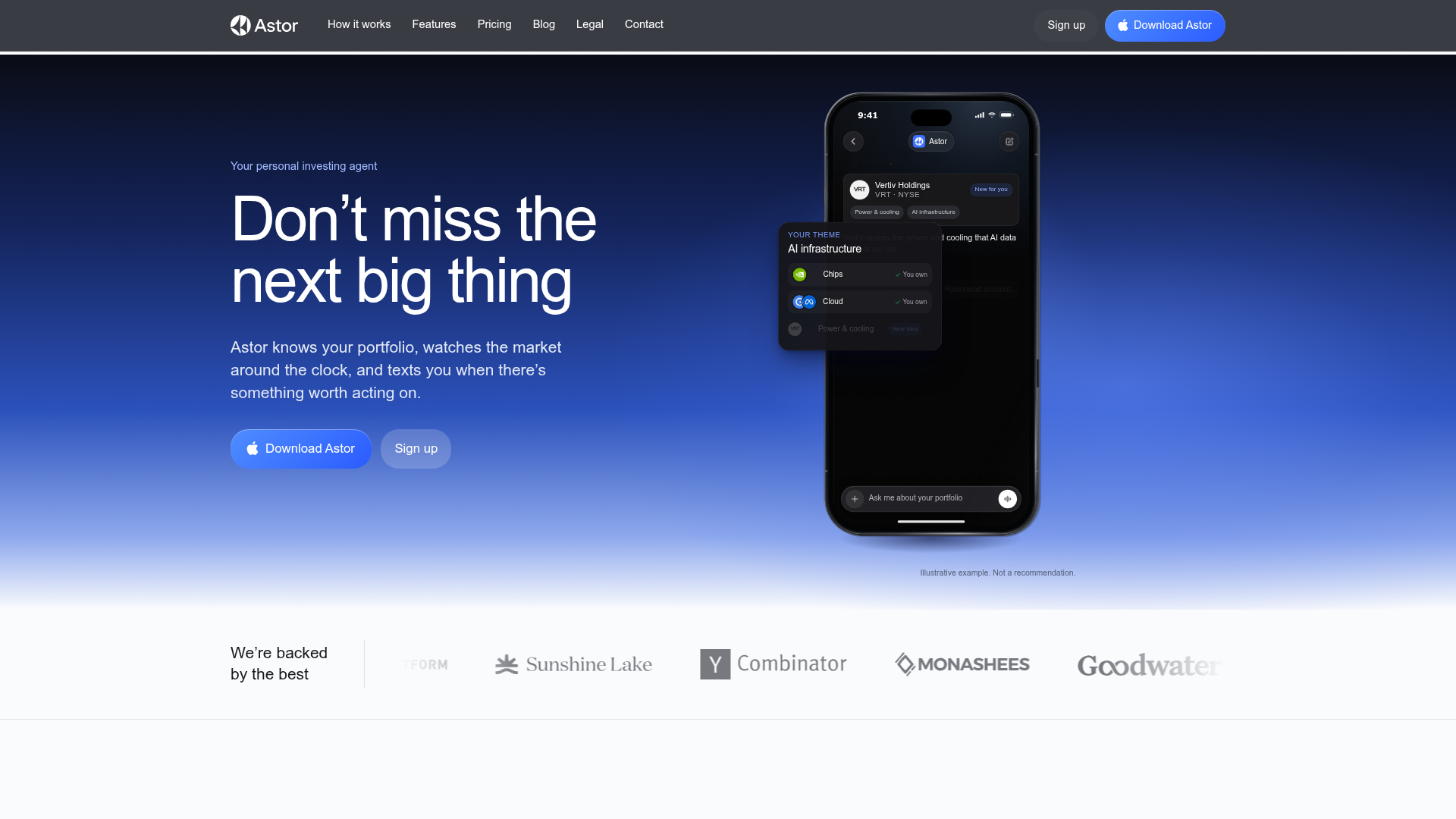
A real adviser’s regulatory filing can confirm that a company exists while leaving the ownership of a landing page unsettled. That is the central issue with aitechlaunch.com. The page presents Astor as a personal investing agent, displays a simulated portfolio and names Gaus, Inc. in its disclosures. A document hosted by the US Securities and Exchange Commission corroborates the adviser’s identity. To establish who receives contact details submitted here, a reader needs a separate connection to this specific web address. Landing page
Start With the Filing
The client relationship summary dated June 22, 2026 identifies Gaus, Inc., doing business as Astor, as a registered investment adviser. It describes non-discretionary services in which retail investors make the ultimate purchase or sale decision. It also explains the distinction between investment advice and brokerage. The adviser’s legal page gives CRD number 338424 and links to agreements, terms and disclosures on the astor.app domain.
These sources provide a route to the firm independent of the landing page. Neither source used in this review establishes that the firm authorised aitechlaunch.com to collect prospective clients’ details. The sensible question for the adviser is narrower than whether Astor exists: does it own, operate or approve this exact host and the registration form reached there? An answer should identify the domain explicitly and explain who processes submissions.
What the Demo Is Showing
The captured page illustrates a portfolio value above half a million dollars and a change in value for the day. Its own accompanying text describes an illustrative app demonstration. The sequence depicts a portfolio overview, an alert about a theme and an order requiring approval. Figures presented in this context are examples of an interface. They cannot support a claim about a real client’s portfolio, an audited investment return or a trading strategy’s historical success.
The distinction matters if an invitation to aitechlaunch.com is accompanied by a claim of autonomous profits. The landing copy says the user approves each trade and describes a Robinhood account for the trading feature. The adviser’s published terms likewise say the user approves individual orders. A private pitch promising someone else will routinely move money without further approval would need separate attribution and comparison against the actual agreement.
Several links on aitechlaunch.com, including sign-up and download controls in the retrieved page, point to a path on the same host containing landers/land-545-1. The retrieved material also includes a form for full name, email and an optional phone number. Its acknowledgement text promises later contact. The form was not submitted. Its presence establishes what information the page invites a visitor to provide, while the recipient of a submission remains unverified.
A useful check is to compare the onboarding route obtained independently from the adviser with the one in the original advertisement. Preserve the initial address, any redirects, the destination shown when a button is selected and the email domain of any subsequent contact. If someone asks for a bank transfer, record that as a separate event. Opening a promotional page, subscribing to software and funding a brokerage account involve different recipients and permissions.
Subscription Prices and Payment Instructions
The FAQ on aitechlaunch.com quotes free entry, a Pro subscription at $19 monthly and a Max subscription at $29 monthly. It gives lower monthly equivalents for annual billing. A quoted monthly equivalent does not specify the amount charged immediately unless the billing period is also known. The June relationship summary describes subscriptions purchased through the mobile app as billed through Apple. That makes the purchase channel material when comparing a payment request with the filed disclosure.
No app was installed and no payment was made during this review. The evidence therefore cannot establish that a checkout processed a real subscription or identify the recipient of any later payment demand. If a disputed charge already exists, retain the receipt and descriptor rather than relying on a logo in a forwarded message. The reporting guide explains how to assemble those records.
Keep the original advertisement even when the landing page later changes. The referral source can help the adviser distinguish a campaign it commissioned from an approach it never authorised.
Frequently Asked Questions
Does SEC Registration Authenticate Every Site Using the Name?
The filing establishes the adviser’s regulatory identity. It does not establish control of aitechlaunch.com. Confirm a proposed onboarding address through a contact reached independently from the adviser’s own disclosures before sharing personal information.
What Does the Illustrated Balance Tell a Reader?
It shows how a portfolio might appear in the advertised application. It provides no dated account statement or trade history from an identifiable customer. The publisher describes the example as illustrative, so a reader should evaluate investment performance using separate evidence.
Conclusion and Reporting Guidance
The adviser named on aitechlaunch.com can be identified from a dated filing, but that finding stops short of authenticating this landing page. Before submitting contact details, ask the adviser to confirm the exact URL through its independently located channel. Someone reporting an approach can preserve the original advertisement and follow-up messages so a reviewer can distinguish the source of the branding from the source of the solicitation. Financial fraud reporting guide · Submit the original invitation