
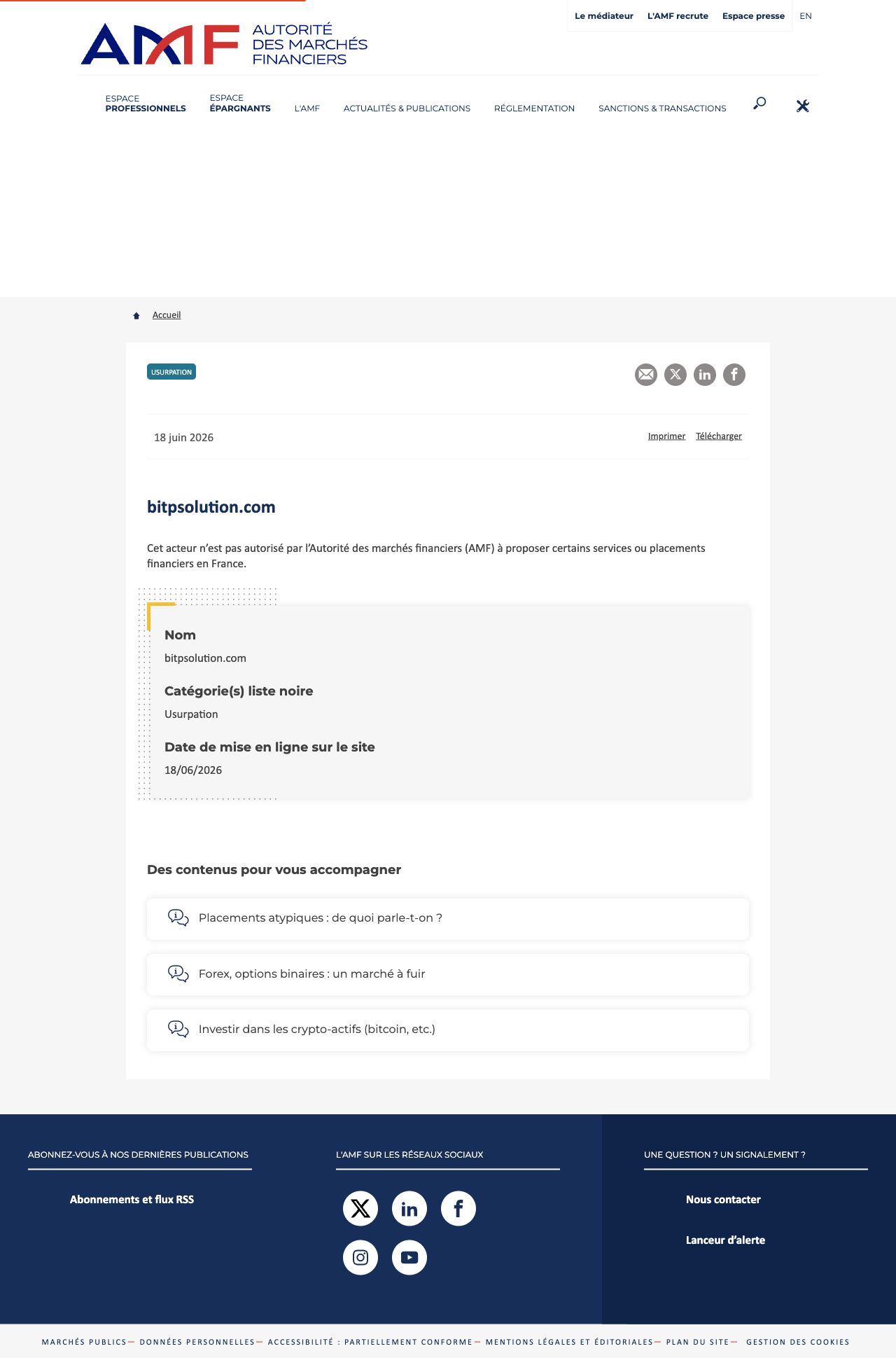
Our bitpsolution.com review found an exact-domain AMF impersonation-category warning and a secondary description of a PIN-entry page. The current site and identified path did not yield a working interface in our retrievals. These records support caution, but they do not establish a particular stolen credential, customer loss or responsibility of a genuine financial firm.
Three Different Claims to Distinguish
- An official impersonation-category warning is verified.
- A historical PIN interface is described by a secondary publisher.
- A completed theft or a genuine firm’s responsibility was not established.
What the Official Impersonation Entries Say
June 18 Is the Original AMF Publication Date
The domain warning was published June 18, 2026. A separate official entry records the pattern prénom.nom@bitpsolution.com in the same category and on the same date. That pattern is a regulator-listed designation, not a verified personal mailbox or named employee.
No current operator licence certificate was retrieved; the notice concerns permission in France.
Sources: French AMF Notice; AMF Protect Epargne Email-Pattern Warning.
Bitpsolution.com and Genuine-Firm Attribution
The AMF categorises bitpsolution.com under Usurpation, or impersonation. Its short domain notice does not name a particular genuine firm as the responsible operator or the imitated party. We did not establish the legal counterparty behind the site.
Similar branding and secondary allegations should not be used to assign the warned conduct to an unrelated registered business.
Sources: French AMF Notice; Exact-Website Retrieval Attempt.
How to Read the Historical PIN Description
A PIN Page Is Not an Investment Plan
BrokerDefense’s March 26, 2026 article describes an isolated bitpsolution.com/pincode.php interface requesting a PIN, without a clear product offer. That is attributed historical observation, not a page we successfully tested. No plan name, investment rate, deposit threshold or principal-return condition was authenticated.
We did not enter a code or provide personal details.
Sources: BrokerDefense Historical PIN-Page Report; Exact-Website Retrieval Attempt.
The PIN Description Does Not Prove a Completed Theft
The secondary article interprets the interface as a collection mechanism. We did not observe a submission, credential transfer or resulting debit. Nor did we verify trading fees, withdrawal terms or a customer balance.
The report’s legal-assistance invitation is not evidence of a successful recovery. Specific transaction allegations would need original records and independent corroboration.
Sources: BrokerDefense Historical PIN-Page Report; Exact-Website Retrieval Attempt.
Contacts, Company Attribution and Complaint Limits
Email Patterns and Telephone Allegations Have Different Provenance
The official email-pattern warning is primary evidence. BrokerDefense also lists multiple phone numbers and reported identities, but we did not corroborate their use from original customer files. They are not presented as verified current support contacts.
No physical address, current staff identity or office-occupancy result was established for the warned domain.
Sources: AMF Protect Epargne Email-Pattern Warning; BrokerDefense Historical PIN-Page Report.
Sources: Exact-Website Retrieval Attempt.
An Impersonation Context Requires a Documented Link
No operator company number and jurisdiction were reliably established. A unique official corporate-registry match remains incomplete, and an innocent namesake has not been substituted for the site. Incorporation details found elsewhere would need evidence of authorised use of the domain before they could identify the counterparty.
The short warning alone does not make that link.
Sources: French AMF Notice; Exact-Website Retrieval Attempt.
Keep the Domain Warning Separate From Unverified Customer Claims
The AMF domain notice and email-pattern entry provide the verified regulatory concern. ABE’s indexed list uses June 19, 2026 as its listing date; the AMF’s June 18 date remains the original notice date. No original customer complaint file, proven loss amount or court determination of credential theft was examined for this review.
Sources: French AMF Notice; AMF Protect Epargne Email-Pattern Warning.
Sources: Indexed ABE List Including Bitpsolution.
Domain Events and the Remaining Questions
Registry Dates Versus a Historical First Detection
Verisign records registration on November 24, 2025, expiration on November 24, 2026 and Name.com, Inc. as registrar. The last-changed event is April 1, 2026, with client transfer prohibited. The secondary report’s November 25 first-detection date is not necessarily a registration contradiction.
Neither an update nor the report’s shutdown narrative independently dates when the site became unavailable.
Sources: Authoritative Registry RDAP Check; BrokerDefense Historical PIN-Page Report.
No PIN, Account or Outreach Test Was Performed
We did not contact a person using the listed email pattern or submit a PIN to pincode.php. No operator explanation was requested, so silence is not an adverse finding. An original message, transaction instruction and independently verified counterparty would be needed to resolve the responsibility question.
Where the Report of a PIN Screen Came From
The official impersonation warning and the secondary description of a PIN page establish different things. A dated capture of the exact path would help verify what visitors saw. A claim that a visitor submitted a PIN would additionally require evidence of that interaction.
Frequently Asked Questions
What Does the Email Pattern Establish?
The AMF lists a first-name/last-name pattern at the domain. It does not identify an authenticated individual employee or tested support mailbox.
Did This Review Test the PIN Form?
No. The page description comes from secondary historical reporting; no PIN or personal data was submitted.
Who Was Being Impersonated?
The short official domain notice examined does not identify a specific genuine firm. Responsibility and affiliation require further evidence.
Conclusion and Reporting Guidance
Bitpsolution.com has a verified AMF impersonation warning, but the examined notice does not identify a genuine firm responsible for the site. The historical PIN-page description remains attributed secondary evidence. We did not establish a completed credential theft, a loss total or a verified withdrawal refusal.
Current operator identity and the original context of any solicitation remain unresolved.
If you received a solicitation, preserve the original message, headers, exact link and claimed identity. If you shared a code or suspect account misuse, contact the relevant institution promptly through independently obtained details. For a disputed payment, keep the transaction record and ask the provider about available options.
Do not assume that a company mentioned in a message authorised it.
The clone-firm guide explains independent affiliation checks. Our scam-type resources give background without proving a particular mechanism. Use the reporting guide to organise the original solicitation and payment evidence.
Evidence Sources
- Exact Website Retrieval Attempt: bitpsolution.com — checked November 4, 2026.
- Original AMF Warning for bitpsolution.com — checked November 4, 2026.
- BrokerDefense Historical PIN-Page Report — checked November 4, 2026.
- AMF Protect Epargne Email-Pattern Warning — checked November 4, 2026.
- Authoritative Domain Registry Check: bitpsolution.com — checked November 4, 2026.
- Indexed ABE List Including Bitpsolution — checked November 4, 2026.