
A mortgage example on capitalcalcs.com deserves a numerical check before readers rely on it. The homepage states that a $400,000 mortgage at 6.8% over 30 years incurs $319,306 in interest. Applying the site’s published amortization formula to those inputs instead produces approximately $538,772.27 in interest. That identifies a discrepancy in the homepage example, not a finding that every calculator is wrong. Example Methodology
Capitalcalcs.com Offers Estimates, Not Loans
The site provides mortgage, auto-loan, retirement, annuity and debt-payoff tools, alongside crypto calculators and market information. Its terms dated June 18, 2026 describe an educational service and say it is not a lender, bank, broker or investment adviser. This is therefore a review of financial information and disclosures rather than a deposit-taking business.
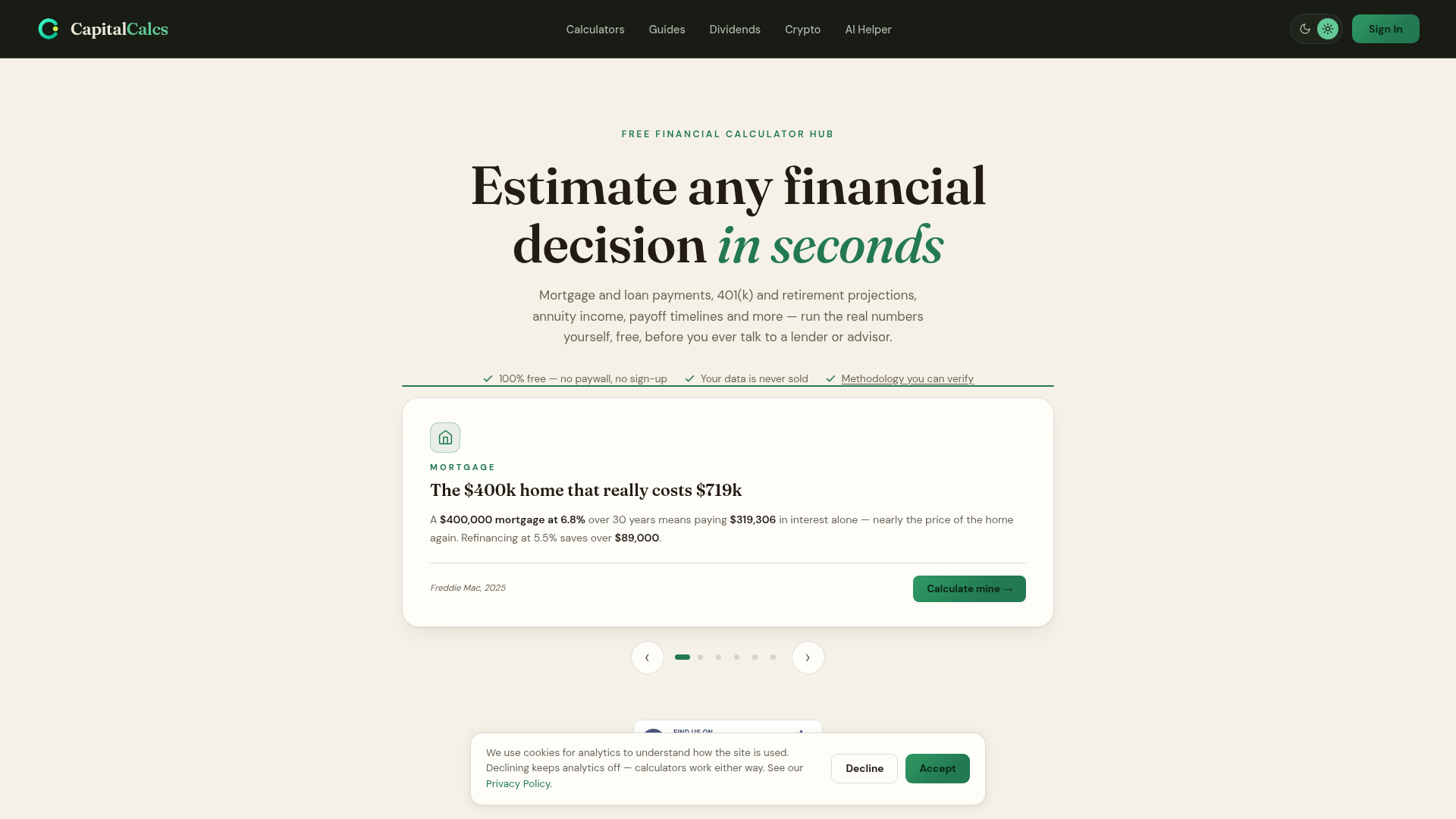
The screenshot shows the calculator hub and its mortgage illustration, with cookie controls visible below. The main tools are advertised as free without signup, while saving scenarios and using the AI helper involve account features. Those are different access conditions; the presence of a registration option does not contradict free access to the basic calculators.
Reproducing the Mortgage Arithmetic
The methodology gives the standard monthly amortization formula using principal, monthly interest and payment count. With principal $400,000, monthly rate 0.068 divided by 12 and 360 payments, the calculated principal-and-interest payment is approximately $2,607.70. Multiplying the unrounded payment by 360 and subtracting principal gives the interest figure above.
This calculation assumes a fully amortizing, fixed-rate loan with monthly payments and no extra principal. It excludes taxes, insurance, fees and refinancing. Those assumptions matter: the check addresses the numerical example as written, not a personalized mortgage quote or a test of every interactive input on capitalcalcs.com.
The homepage’s stated interest differs by approximately $219,466.27. A different principal, rate or repayment pattern could yield another result, but none was specified in that promotional sentence. The review did not establish whether the cause is stale copy, a different scenario or a calculation defect elsewhere in the application.
Assumptions Behind Other Projections
The methodology says mortgage estimates can add property taxes, insurance and private mortgage insurance. Retirement projections use assumed growth and a withdrawal-rule illustration; debt tools compare repayment approaches. These disclosures give readers variables to examine, but publishing a formula is not the same as independently validating each implementation. Calculation Notes
For capitalcalcs.com, a useful distinction is between an adjustable assumption and a promised outcome. A projected investment return depends on the rate entered; a loan payment depends on the contract’s actual terms. capitalcalcs.com acknowledges that actual outcomes can differ.
The homepage also displays dividend vehicles with yields and account-opening prompts. The methodology identifies third-party market-data sources and warns that information can be delayed or unavailable. The captured table lacked price values; its yields are not verified quotations or investment recommendations.
Privacy Changes When a Scenario Is Saved
The privacy policy says unsaved calculator inputs are processed in the browser, while saved scenarios are associated with an account. It describes Firebase services, analytics, cookies and messages sent to a third-party AI provider. These are policy statements, not the result of a network-traffic audit.
The terms say the operator is an individual sole proprietor based in Georgia, United States, but the reviewed disclosures do not identify that person by name. They also disclose affiliate commissions. The combination supports asking who operates the service and where an account-opening link leads, without assuming that the linked financial provider is CapitalCalcs itself.
Verisign records capitalcalcs.com registration on June 15, 2026. That event is consistent with a recently documented website, but it cannot authenticate the operator or establish professional qualifications. No corporate-registry match, paid service test or direct operator response was obtained. Registry Record
Frequently Asked Questions
Does the Discrepancy Prove the Interactive Mortgage Tool Is Broken?
No. The completed test recalculated the homepage’s written example from its stated inputs. It did not exercise the full interface or identify the underlying cause. A separate test would be needed to compare saved inputs, displayed outputs and implementation behavior.
Are Calculator Projections Financial Guarantees?
The terms explicitly treat outputs as estimates. A projected balance or repayment date remains conditional on assumptions, and it should be compared with actual contractual figures. The site’s own liability language does not independently establish that a particular estimate is accurate.
Does Free Use Mean No Data Is Collected?
The policy distinguishes unsaved calculations from account activity, analytics and AI messages. Free access does not mean all interactions remain on the device. No account was opened during this capitalcalcs.com review, so the behavior of saved scenarios was not independently tested.
Conclusion and Reporting Guidance
The strongest finding is reproducible: the published mortgage example does not match the stated amortization inputs. The cause and scope remain unresolved. Use the tools as preliminary illustrations, independently check consequential figures and preserve the exact inputs when asking for a correction.
The investor-rights overview helps distinguish information services from financial counterparties. If reliance on a figure becomes part of an actual dispute, retain the dated example and calculation through the evidence checklist and consult the reporting guide. A numerical error alone does not establish fraudulent intent.
Sources
Calculator Homepage · Methodology · Terms · Privacy · Domain Record