
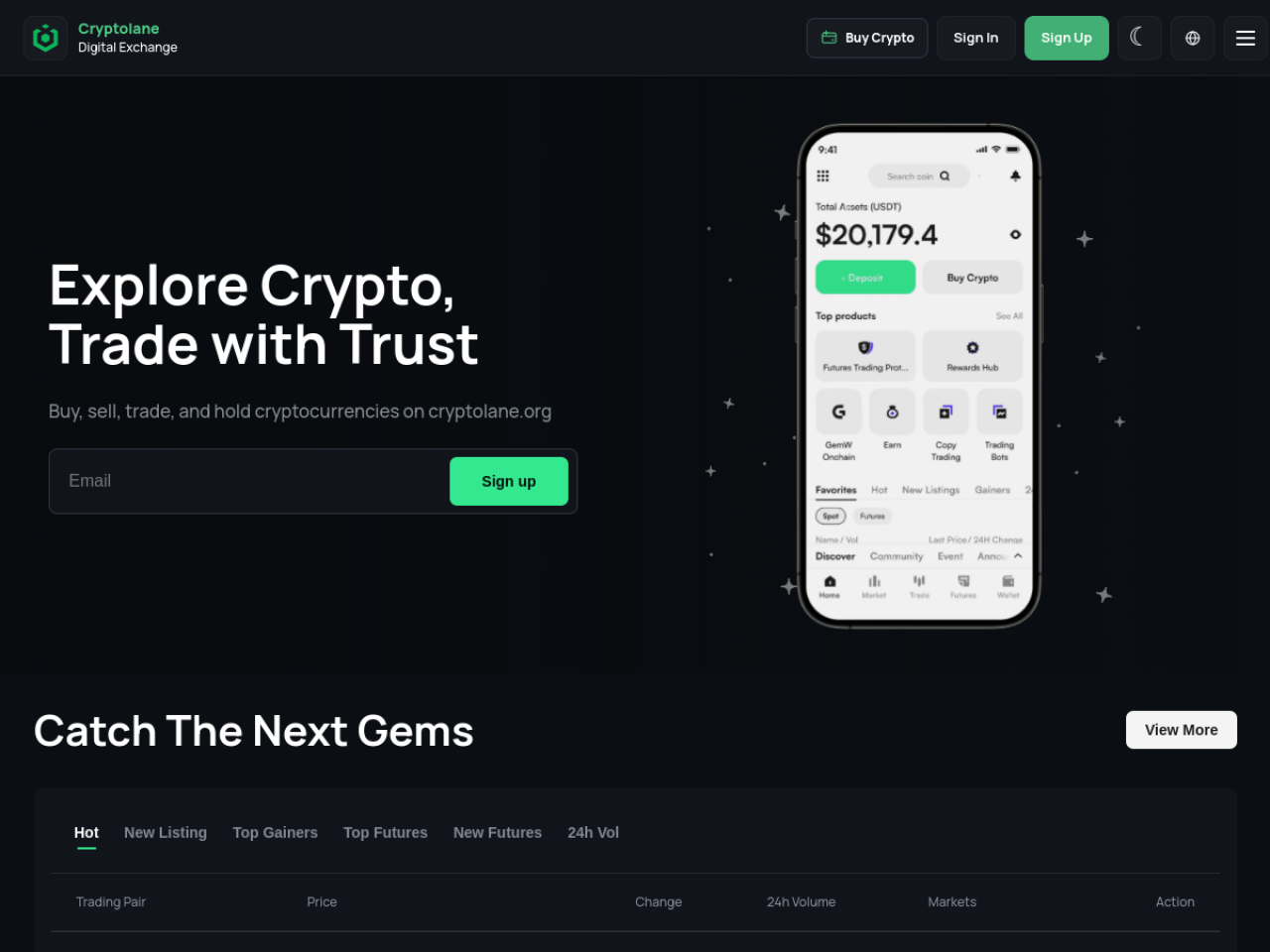
Cryptolane.org looks like a cryptocurrency exchange and publishes detailed maker, taker and deposit charges. Its legal pages name a UK company that can be found in Companies House. The central unresolved issue is whether that company actually controls the domain and provides the advertised exchange or lending service. A numerical match in a company register cannot, by itself, establish the connection.
Who Is Named in the User Agreement?
The terms published on cryptolane.org say the agreement is with DIGITALK DASH Limited, trading as Cryptolane, company number 14018271. They give a fifth-floor address at 167–169 Great Portland Street, London W1W 5PF. Support and legal notices use separate mailboxes on cryptolane.org. The privacy policy repeats the company number and calls the company the data controller.
Companies House independently lists DIGITALK DASH LIMITED as active, incorporated April 1, 2022, with the same number and registered address. Its SIC classification is management consultancy other than financial management. A SIC code is a description on the corporate record. It does not establish cryptoasset registration, custody permissions, domain ownership or misuse of the company's identity.
The current .org record dates domain registration to July 14, 2026, years after the company was incorporated. An Alertopedia review dated August 2 recorded the same domain and two contact emails but gave the company as unknown. The later visible terms supply a name to investigate. They do not establish who wrote the earlier version or independently resolve who operates the exchange.
Fees and Legal Terms on cryptolane.org · Company Record for the Number Quoted on cryptolane.org
Trading Tiers at cryptolane.org
The fee schedule at cryptolane.org puts monthly trading volume below $1,000 in Basic, at 0.10% maker and 0.15% taker. Its Starter band from $1,000 to $10,000 lists 0.09% and 0.13%. Active, from $10,000 to $50,000, lists 0.08% and 0.12%. These are fees on executed trading volume, distinct from the amount credited for a deposit.
Trader, from $50,000 to $250,000, lists 0.06% maker and 0.10% taker. Pro, from $250,000 to $1 million, lists 0.05% and 0.09%. VIP begins at $1 million and shows 0.04% and 0.08%. The headline starting fees are therefore the highest-volume row's figures. The schedule does not demonstrate the price at which any live order actually filled.
Cryptolane Fees and Legal Disclosures
Deposit Minimums and Commissions Are Separate
The asset table lists a minimum of 0.00005 BTC with an estimated deposit commission of 0.0000123721 BTC, while the USDT row lists a 10 USDT minimum and approximately 1 USDT commission. The amounts use different assets and units. Neither should be read as a universal fee for sending coins to or from every network.
Some values deserve clarification before they could be used in an estimate. The SOL row gives a 0.01 SOL minimum and a commission of approximately 0.010276 SOL. The displayed DOGE commission is approximately 12.8567 DOGE against a five-DOGE minimum. The page does not explain how a minimum-sized transfer would be credited in those cases. No test transfer was made.
Cryptolane Fees and Legal Disclosures
Staking, Lending and the Cold-Wallet Claim
The Earn page at cryptolane.org says users may receive daily staking income without risking principal. It also describes lending to the exchange, displaying rates from 0.3% to 24.85% of revenue and marking the lending feature as forthcoming. A percentage of revenue is not the same as annual percentage yield on a deposited balance. No verifiable term, compounding basis or principal-protection contract was obtained for that range.
The page claims 96% of digital assets are held in cold wallets. That statement gives no wallet inventory, independently signed proof of control, liability reconciliation or insurance coverage. A market ticker and a visible account balance are similarly limited: they are interface displays, not an audit of whether customer liabilities are fully backed.
What the Available Complaints Establish
Alertopedia labels the site an apparent fake exchange and describes patterns seen in other cases. Its entry says it knows of no regulatory report about the domain. An editorial classification by a commercial site is not a regulator order. The general pattern it describes cannot establish a specific blocked withdrawal, demand for an unlock fee or proven customer loss here.
The Public Interest Registry response supplies the July registration event and a later August update. Neither event identifies a customer, authenticates a blockchain transaction or verifies the status of the service shown on the November homepage.
Alertopedia Commercial Assessment · Registry Lookup for cryptolane.org
A Fee Schedule Can Be Checked Against an Actual Fill
The published maker, taker and deposit charges offer a concrete comparison for a customer statement. Retain the rate in force when the transaction occurred. The resulting arithmetic can identify a fee discrepancy even while responsibility for the website remains unresolved.
Frequently Asked Questions
Can the UK Company Be Held Responsible Based on This Match?
The number and address match. Whether the company approved the site, operated the exchange or entered a particular agreement is a separate evidentiary question. No director or shareholder can be assigned responsibility for the site's conduct on this evidence alone.
Which Records Would Make a Withdrawal Claim Checkable?
Preserve the requested asset and network, the withdrawal reference, the submitted destination and any transaction hash from the provider. A credit in an internal ledger and an on-chain transfer are different events. Evidence of one does not automatically prove that the other happened.
Conclusion and Reporting Guidance
The public fee table and company disclosures are documented, but domain control, custody, financial authorisation and advertised earnings remain unresolved. The promising language about protecting principal is unsupported by independently verifiable assets or performance in the material reviewed.
If reporting a transaction, identify the domain, legal name actually printed on the agreement and the receiving wallet. A complaint should distinguish a trading fee from a deposit commission, a network fee and any later request to pay money before a withdrawal can proceed.