
Germany’s BaFin issued an exact-domain warning about de-capitalus.com on October 7, 2026. It said financial, securities and cryptoasset services were being offered without the required permission. The notice also described apparent misuse of two Australian companies’ identities. That official finding outweighs an automated website score, but does not identify the actual operator. BaFin Notice
De-Capitalus.com and the Two Certificate Claims
BaFin says the operator used the name Decapitalus and claimed a business location in Brussels, Belgium. According to the notice, the website referred to two certificates supposedly originating from CapitalFinance Australia Limited and Hmc Capital Investments Limited. The regulator questions the claimed connections.
The notice explains that the first company is registered with Australia’s APRA and the second with ASIC. BaFin reported having no information that either was actually connected with the website or its offers, and characterized the situation as apparent double identity misuse. This review attributes that conclusion to BaFin rather than independently alleging conduct by those companies.
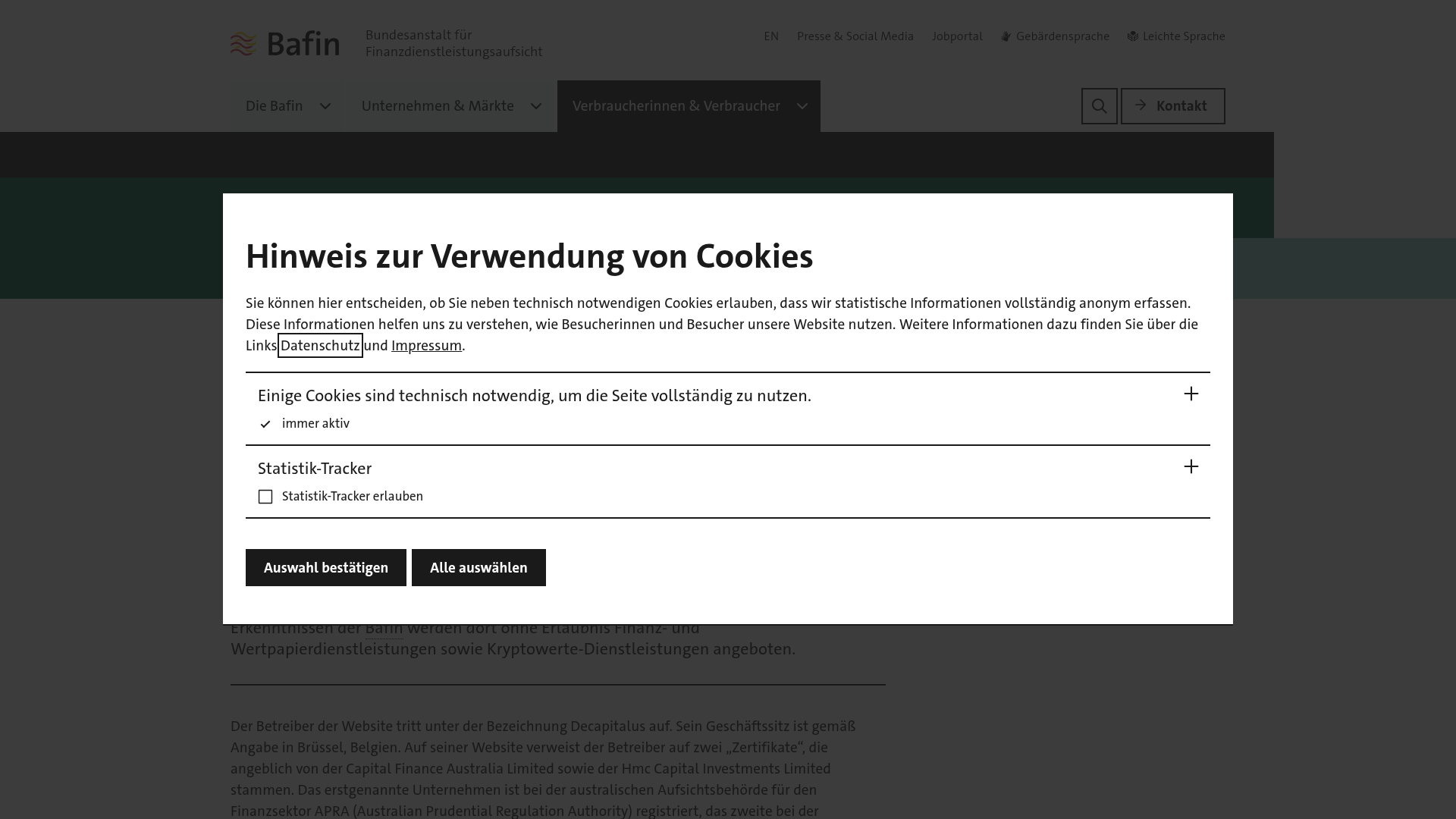
The evidence image is a November 6 capture of the regulator’s page, partly covered by its cookie-consent panel. It is not a recovered image of the trading platform. The readable text was retrieved separately from the same notice, so readers can check the full finding at the linked primary source.
Permission and Identity Are Separate Questions
For de-capitalus.com, the notice establishes BaFin’s finding about services offered without its permission in Germany. It does not establish that an Australian registration could authorize those offers, or that a certificate naming a genuine firm belongs to the website operator. The claimed relationship must be verified before a registration number can carry evidentiary weight.
The review did not separately retrieve corporate extracts for either Australian company. Their regulatory registrations are described here as reported by BaFin. No directors, employees or addresses belonging to those firms are attributed to Decapitalus, and the warning should not be republished as an allegation that the genuine companies ran the website.
This distinction also affects correspondence. A person attempting to verify an offer should locate the genuine firm’s contact details independently, rather than use a phone number supplied with the disputed certificate. InvestorWatchdog’s clone-firm explanation describes why a matching corporate name alone cannot authenticate an approach.
What the November Access Failure Shows
HTTP and HTTPS requests to de-capitalus.com failed DNS resolution on November 6. The browser could not translate the hostname to an address. That observation establishes a failure during the checks; it does not establish a permanent closure, the date activity ceased or whether customers were being directed to replacement sites.
The Verisign record gives a registration event of June 10, 2026 and includes client hold among its current statuses. It also records an update on November 5. The record does not explain the reason for that status or prove that the update transferred control. It cannot establish who benefited from customer payments.
The de-capitalus.com chronology is limited: the domain existed by June, BaFin published its warning in October, and the November visit failed. Registration, regulatory publication and accessibility are different events. Combining them into an unsupported story about a shutdown or enforcement seizure would go beyond the available evidence.
Product Terms and Customer Outcomes Remain Open
No live account agreement, complete fee schedule, deposit minimum or withdrawal policy was recovered from de-capitalus.com in this review. Indexed references to account tiers do not supply enforceable terms. The regulator’s broad service description does not establish every instrument or payment method that an individual customer may have encountered.
Likewise, the warning is not a quantified customer-loss judgment. This research did not authenticate a withdrawal refusal, trace a payment to a beneficiary or obtain a customer contract. Those gaps should remain explicit even when an official notice establishes a substantial reason for caution about the offer.
Frequently Asked Questions
Does the Warning Name the Real Operator?
It names the Decapitalus presentation and describes the claimed Brussels location, but does not identify the actual controllers. The two Australian firms appear in the discussion of apparent identity misuse. Treating either as the website operator would reverse the notice’s meaning.
Is the Site Proven to Be Permanently Closed?
No. The fresh requests failed and the registry showed client hold. These observations establish neither permanent closure nor an enforcement order. Later approaches need separate evidence.
Does BaFin Establish an Individual Refund Entitlement?
The notice establishes the regulator’s warning and permission finding. An individual’s contractual or recovery position depends on their documents, payment route and circumstances. The warning alone establishes no particular loss.
Conclusion and Reporting Guidance
The strongest de-capitalus.com evidence is BaFin’s October notice, including its separation of genuine company identities from the disputed offer. Actual control, transaction beneficiaries and customer outcomes remain unresolved. The article retains those research limits while treating the verified warning as a material reason to pause an unsolicited offer.
No operator approach was made during this research. Anyone reporting a transaction should preserve the certificate images, messages, account agreement and original payment references. Use the reporting guide and supporting-evidence checklist, and identify the October 7 notice precisely so a reviewer can distinguish the named firms from the alleged misuse.
Sources
BaFin Warning of October 7, 2026 · Authoritative Domain Record