
Five Australian dollars a week buys access to the advertised Harvest Bots toolkit. The more consequential price of entry on earncurveinvest.com is a set of permissions. Its instructions tell customers to generate a key on their main exchange account, allow withdrawals and accept connections from any IP address. The same instructions describe a virtual subaccount for profits. These are different controls, and confusing them changes a reader’s understanding of what is exposed. Harvest Bots setup instructions
Follow the Setup Across Three Addresses
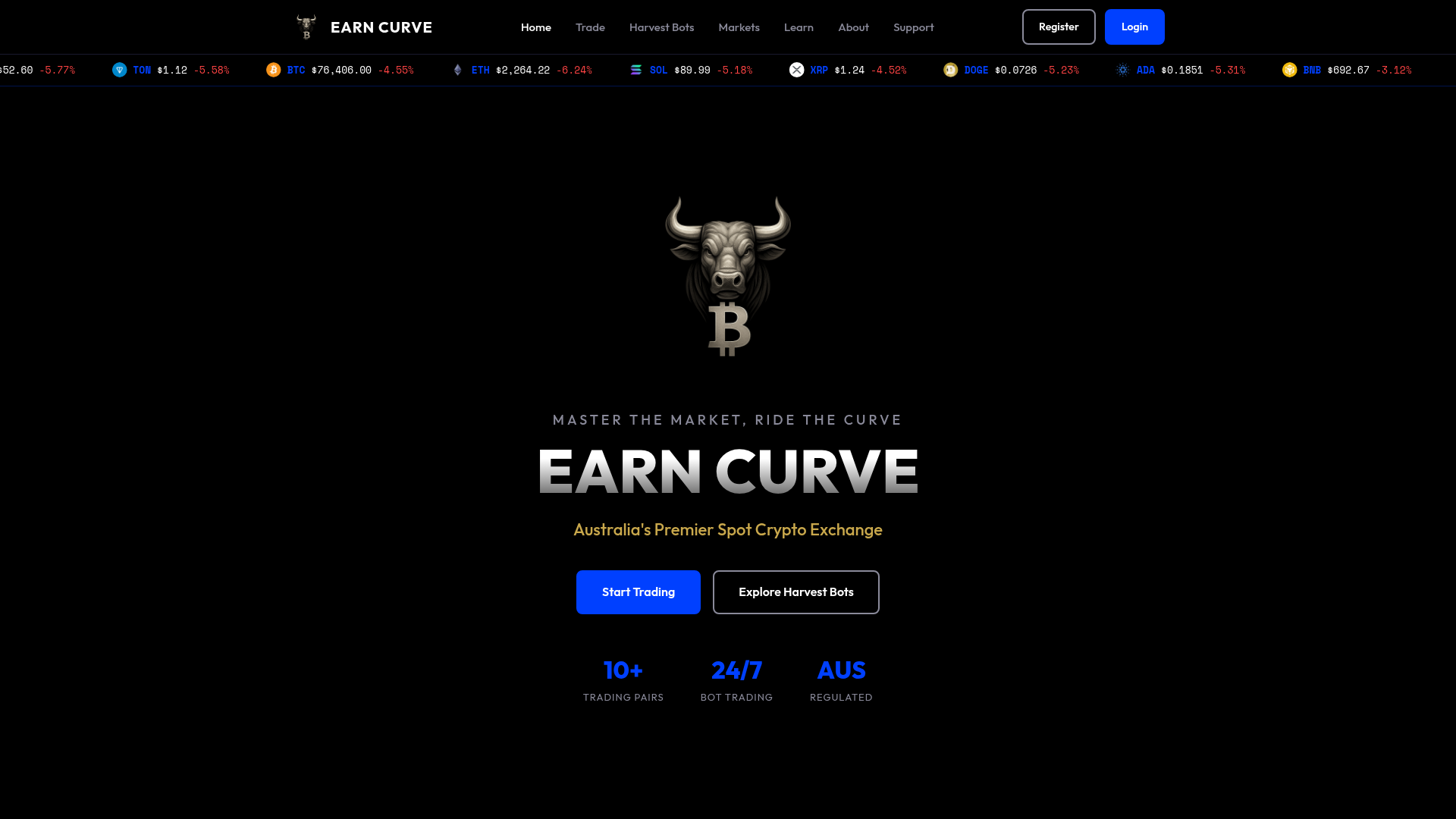
The exchange homepage presents a Melbourne-based Australian spot exchange with cryptocurrency pairs quoted in USDT. The registration and login links shown there lead to earncurve.com.au. Meanwhile, the bot instructions send prospective subscribers to earncurveharvestbots.com and describe paying through PayPal. The customer is then directed back to earncurveinvest.com to create a virtual subaccount. The pages make these connections in their own instructions. Linking the three hosts does not independently establish common ownership.
There are also three separate financial events. A subscription pays for access to software. A deposit funds an exchange balance. A transfer between main and virtual accounts is described as an internal movement. A PayPal receipt for the first event cannot establish the exchange received the second or that a customer can withdraw the third. Someone reconciling payments should record the currency and recipient separately for each one.
Read, Trade and Withdraw
The instructions on earncurveinvest.com specify three permissions by name. Reading allows a connected tool to request information. Trading ordinarily allows it to submit orders within the rights granted to the key. Withdrawal is a separate category that can involve moving assets away from the account. The exact controls enforced by this exchange, including any beneficiary restrictions or additional approval step, were not independently demonstrated. The guide nevertheless explicitly tells the reader to enable all three permissions and set the IP restriction to Any.
The next step asks customers to paste the key and secret into the bot dashboard. A virtual account selected as the destination for trading outcomes does not, by itself, limit a key created on the main account. A meaningful answer would identify the limits enforced by the exchange when that key is used. A diagram of how profits move between balances could explain accounting while leaving authority to initiate withdrawals entirely unresolved.
What the Grid Is Supposed to Do
According to earncurveinvest.com, the trader chooses a pair, price range and investment amount. Limit orders are placed at intervals and the grid adjusts every twenty-four hours. The examples give different trailing ranges for bitcoin and ether. None of those percentages is presented in the instructions as a guaranteed return. A grid can buy an asset at successive levels while its value continues falling. Counting individual completed sales without valuing the remaining inventory would give an incomplete picture of performance.
The guide gives a minimum funding amount of 100 USDT via the TRC20 network. That amount is denominated in a cryptoasset, while the subscription is quoted in Australian dollars. A participant calculating results needs the subscription charges over the same dates, the value of open positions and any trading or network costs. A positive balance labelled profit in a virtual account alone would leave out part of that calculation.
Which Claims Remain Open?
The Australian regulation claim on earncurveinvest.com is made by the site. This review did not establish a registration that independently ties a named legal entity to all three domains or authorises a particular bot arrangement. A prospective customer can ask who contracts for the subscription, who holds the trading balance and who receives the API secret. The answers should identify legal entities and their responsibilities rather than repeat the brand name.
For an existing connection, retain the creation date and permission settings without copying the secret into a report. Order identifiers, withdrawal notices and the receiving address can help reconstruct what happened. The reporting guide explains how to preserve payment evidence. A reader assessing a disputed transfer should also retain any record of when a key was revoked or its permissions changed.
Keep a separate copy of any limits enforced on approved recipients.
Frequently Asked Questions
Does Spot Trading Eliminate the Risk From a Key?
The explanation on earncurveinvest.com describes spot positions without margin or liquidation. That concerns how positions are financed. The permissions attached to a key are a separate issue. A spot account can still grant another application authority to submit orders or request transfers.
What Would Verify a Bot Return?
A starting balance, complete fills, fees and ending inventory can support a return calculation. Separately match deposits and withdrawals to external records. Without those adjustments, money added by the customer could be mistaken for a gain generated by the strategy.
Conclusion and Reporting Guidance
The strongest finding on earncurveinvest.com comes from its own setup sequence: the virtual subaccount receives outcomes, while the withdrawal-enabled key is created on the main account. How the exchange restricts that key in practice remains unresolved. Before connecting, ask for the exact permissions required and the reason a trading strategy needs withdrawal access. For an existing dispute, share the dated permissions and transaction records with secrets removed. Financial fraud reporting guide · Submit redacted evidence