
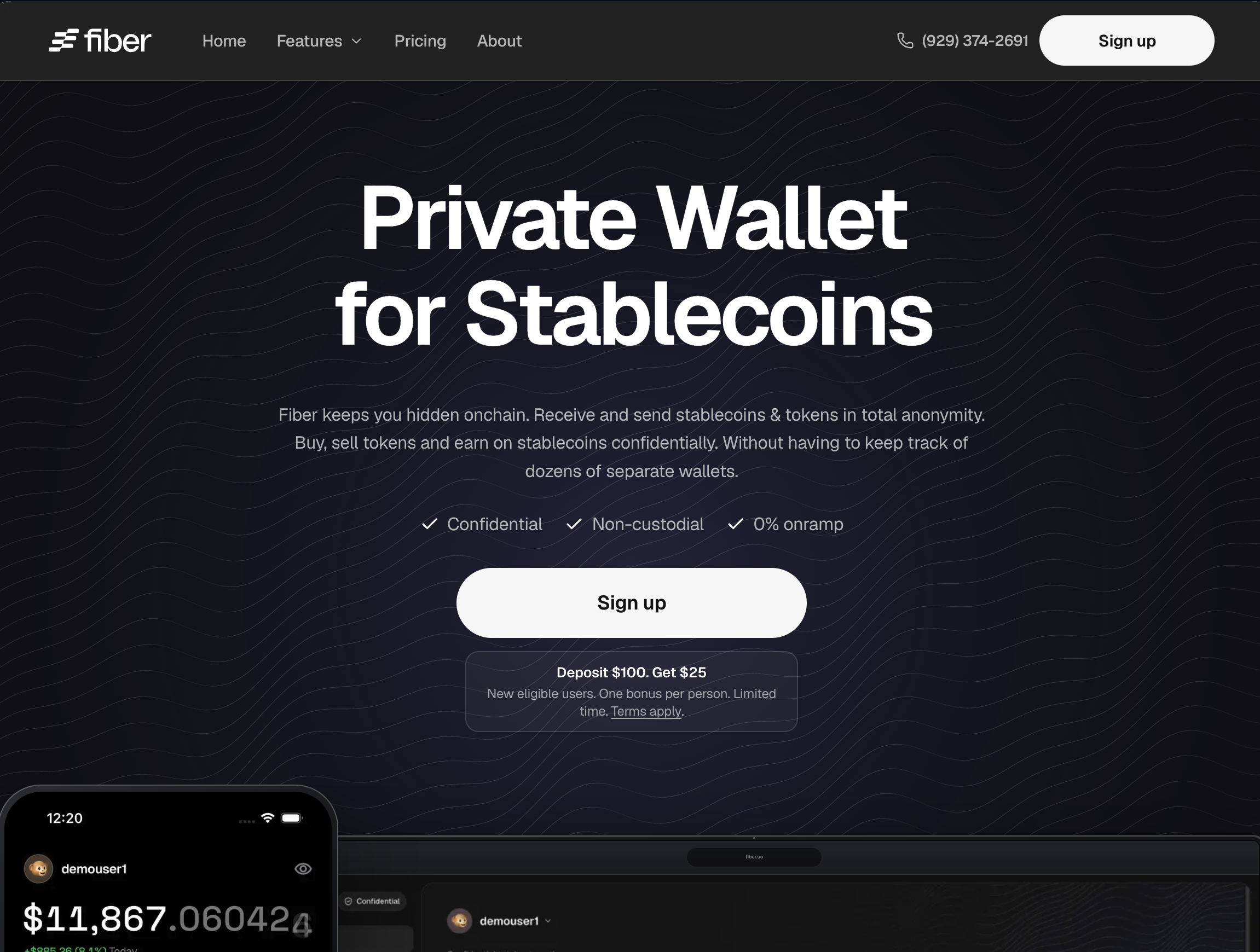
Fiber.so presents a privacy-focused wallet for stablecoins, tokenized assets and bank-linked payment services. The site identifies Merkle Software Inc. as its operator and says the wallet itself is non-custodial. Those disclosures distinguish it from websites that simply ask visitors to deposit cryptocurrency into an opaque investment account. Our November 3, 2026 research found enough public information to describe the service and its key contractual limitations. It did not establish that every advertised integration, transaction or insurance arrangement had been independently tested. Users should evaluate wallet security and each third-party provider separately.
What the Fiber.so does
The Fiber.so homepage advertises private transfers, stablecoin deposits, token trading and earnings opportunities through integrations such as Aave and Morpho. It also describes eligible U.S. ACH and wire services and exposure to tokenized equities. Its documentation sets out supported assets, sending networks, account recovery and operational procedures in substantially greater detail than the marketing page.
Fiber.so’s stated privacy model relies on shielding supported activity and using different addresses. However, its own FAQ explains that public blockchains and integrated providers can still observe information. Phrases about anonymity or leaving no trace should therefore not be interpreted as a promise of invisibility to banks, counterparties, network observers or regulators.
Who operates fiber.so?
The terms, effective July 15, 2025, identify Merkle Software Inc., a Delaware corporation, and list a New York mailing address and legal contact. Its About page identifies founder Théo Powers. An independent Google Play listing identifies Merkle Software Inc. as the developer, lists a support email and provides a separate developer address. This corroborates a publicly identified operator, although a marketplace listing is not an audit of its technical security or banking relationships.
The company Fiber.so describes itself as a financial-technology business rather than a bank. It names an abbreviated banking partner, SSB, Member FDIC, for certain U.S. account services. We have not independently resolved the full bank name and account agreement from an authoritative bank record. Readers must not assume all wallet balances, DeFi positions or tokenized securities are bank deposits protected by deposit insurance.
Fees and headline offers need careful reading
The public pricing schedule states a 25% share of stablecoin rewards, zero Fiber trading fees and zero fees for several deposit and payment routes. It also lists a $14 U.S. wire-withdrawal charge, characterized as a pass-through cost. Crucially, the page warns that spreads, slippage, liquidity conditions and banking intermediaries can produce other costs. A zero platform fee is not the same thing as a zero-cost transaction.
The homepage advertises a $25 bonus after a $100 deposit. The promotion terms condition that reward on eligibility and maintaining at least $100 of net stablecoin deposits for 30 consecutive days. Prospective users should read the offer conditions before moving money; a promotional payment does not validate the wider service.
Yield, insurance wording and custody boundaries
Fiber describes variable rewards potentially reaching 5% annually through outside protocols, while the terms expressly say these returns are not guaranteed. That distinction matters because protocol exposure can involve contract vulnerabilities, liquidity shortfalls and other risks unrelated to the wallet interface. The main page also refers to insurance of up to $1 million for certain Aave and Morpho deposits but labels that proposal as coming soon. It must not be represented as insurance currently in force.
Non-custodial design also shifts responsibility. According to the terms, customers manage their own private keys and may not recover assets after losing credentials or authorizing irreversible transactions. Integrated bank accounts and third-party services can have different custody models and eligibility rules. These boundaries deserve separate confirmation rather than one blanket assessment of the Fiber brand.
Risk assessment and consumer action
We identified no substantiated affirmative item among InvestorWatchdog’s seven scam-watch flags in the accessible evidence. The named operator, founder and published mailing address are material transparency positives. We did not find a domain-matched regulatory warning or corroborated withdrawal-refusal allegation in the targeted public searches undertaken, but neither absence establishes universal compliance or guarantees successful transfers. The resulting provisional low observed-risk classification applies only to these seven editorial indicators, not to smart-contract or product risk.
Before using Fiber, confirm the supported asset and network, export and secure wallet recovery information, read the current terms for any bank account, and verify the identity of the institution holding any fiat balance. Test only with funds you can afford to expose to operational risk. For research standards and correction requests, see InvestorWatchdog’s editorial policy.
Frequently asked questions
Is Fiber a bank?
No. Fiber identifies itself as software operated by Merkle Software Inc.; certain banking services are described as provided by a separate bank partner.
Are rewards fixed or insured?
No fixed return is promised. The site describes variable protocol-based returns, while its headline protocol-insurance proposal is explicitly labeled as forthcoming.
Does non-custodial mean risk-free?
No. Users remain exposed to credential loss, irreversible transfers, smart-contract failures and third-party service limitations, as the published terms explain.
Conclusion: Evaluating Fiber’s Wallet and Financial Services
Fiber.so publishes a named operator and useful disclosures, but a non-custodial wallet still exposes users to irreversible transfers, key loss and risks from connected protocols.
Check the exact asset and network, reward terms, promotional conditions, identity of any banking partner and whether an insurance claim describes current coverage or a future proposal. Keep recovery information secure and never share a seed phrase with someone claiming to provide support.
Readers with documented product experiences, corrections or unresolved issues can submit a report. For broader context, explore other investigations and the InvestorWatchdog education hub.
The observed-risk classification is not a warranty of security or performance.