
The provider field at husher.io displays Husher, but the service terms give another party a central role. According to those terms, Husher routes exchange instructions while third-party exchange service providers process the assets and take custody during a swap.
Reading Both Sides of the Quote
The supplied address led to the www version of the exchange homepage. Its initial screen showed Bitcoin on the send side and Tether on the Ethereum network on the receive side. The form requested a destination and offered fixed-rate and private-exchange controls. We opened no order.
The retrieved figures included an indicative conversion of approximately 80,644 USDT for one BTC and approximate dollar values of $8,064.40 and $8,035.57 for the amounts displayed. The difference between those two dollar estimates was $28.83. It would be misleading to call that difference a confirmed fee without knowing the agreed rate, timing, network costs and order conditions.
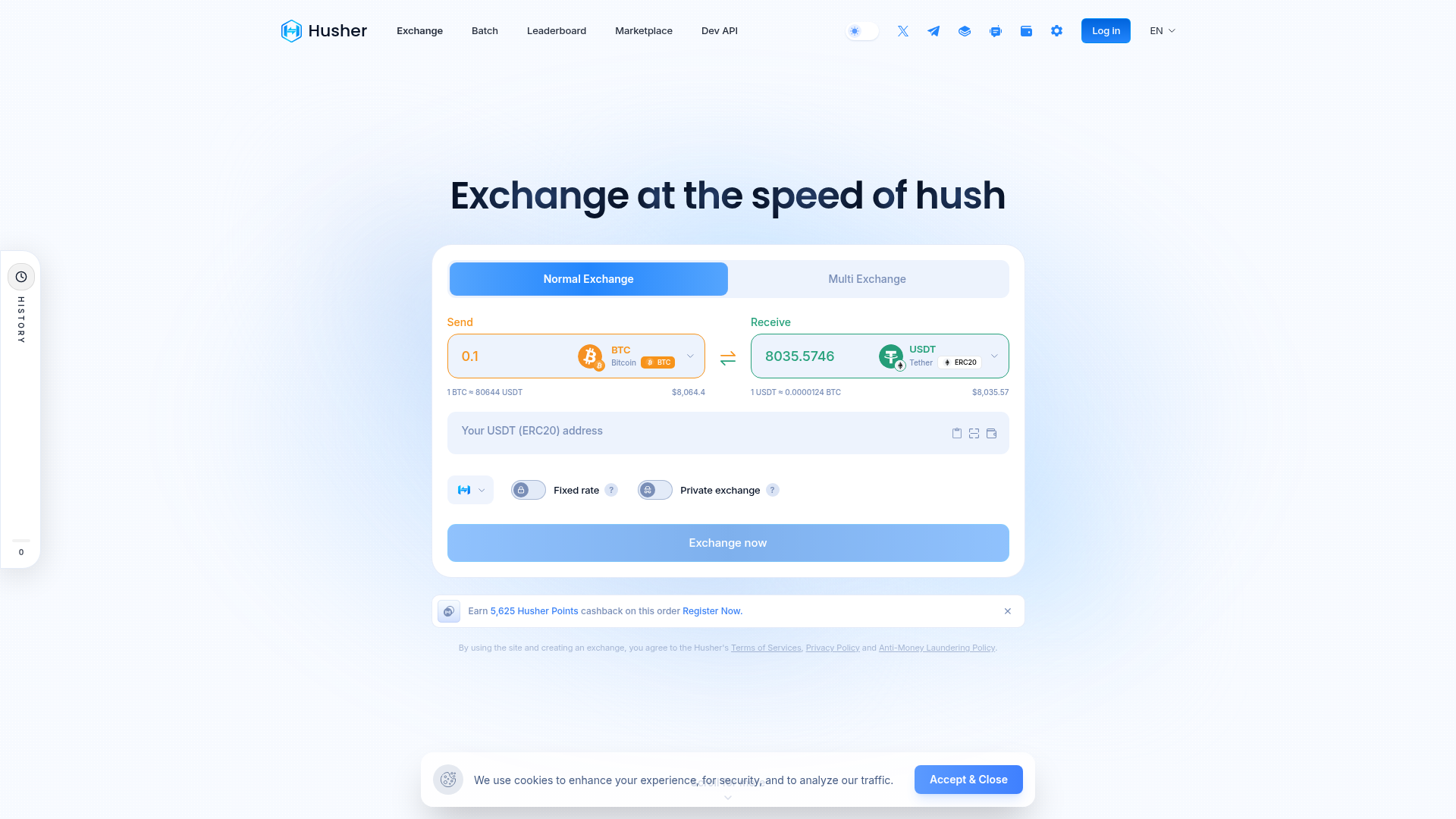
The interface at husher.io also promoted a points award for registration. Points displayed beside a prospective exchange should be evaluated separately from the crypto amount a recipient expects to receive. The reviewed screen did not establish a cash conversion value for those points or show that a particular customer earned them.
The Provider’s Role in a Refund
The Terms of Service carry a November 17, 2025 update date. They describe the website and Telegram bot as ways to reach a routing service. Once an order is placed, users receive a deposit address connected to an exchange service provider. That provider is described as exchanging the funds and forwarding the proceeds to the destination wallet.
The terms say Husher facilitates refund requests while the provider makes the final determination. Ordinarily the refund goes back to the originating address verified on the blockchain. An alternative address is described as possible in rare cases after approval. That is an important consideration for anyone sending from an exchange account whose sending address they do not control.
An external transaction hash can establish the origin and destination of a deposit. It does not, by itself, settle the rate agreed in the order, prove the eligibility of a substitute refund address or identify the team handling a compliance review. Those details require the order confirmation and communications with the service or provider.
Private Routing and Eligibility
The homepage of husher.io describes private exchanges as using assets such as Monero or Zcash in the route. Its service terms also maintain eligibility rules and restrictions. Privacy-oriented routing and an exemption from identity checks are different propositions. The public materials do not give a customer grounds to assume that selecting the private option overrides a provider’s conditions.
The listed restricted jurisdictions include the United States and Canada as well as several European and Asian jurisdictions. The terms also set an age requirement and restrictions involving politically exposed persons. A visitor being able to load the homepage from a location does not establish that the service accepts an order from that visitor.
The terms invoke Panamanian law and request notification of a dispute within thirty days. A governing-law clause describes the publisher’s proposed terms. It does not establish incorporation in Panama or identify the exact exchange provider that held a deposit. We did not verify an independently registered counterparty for a specific order.
What the Fee Language Actually Promises
Husher describes fees as included in the displayed final rate, while explaining that network conditions, provider charges and transaction complexity affect the amount. Its terms also discuss provider-specific charges in connection with certain services and compliance procedures. The reader needs both the original quote and the provider’s actual instructions to evaluate any subsequent demand.
The activity section at husher.io displayed an average execution time of 6.84 seconds. That is a publisher-reported metric. Without an independently verified sample, observation window and definition of completion, it cannot establish how long a held transaction or a refund should take.
A commercial reputation page raises questions about the identity behind the website and mentions cryptocurrency exposure. Its classification does not identify the recipient of an individual deposit. Our registry lookup also failed to supply an authoritative creation record for this review, so the date printed on the terms should not be read as the domain’s registration date.
Frequently Asked Questions
Did the Review Confirm Any Partner Endorsement?
The homepage displays branded posts and third-party names. We did not independently establish that those organizations guarantee a swap through husher.io or assume liability for a provider’s performance. The service agreement is the better starting point for identifying who handles an actual order.
Does Selecting a Fixed Rate Guarantee an Immediate Refund?
A rate choice relates to exchange pricing. Refund eligibility, routing, timing and the applicable address are separate issues governed by the terms and the provider’s decision. We did not verify a completed or refused refund for any particular customer.
Conclusion and Reporting Guidance
The actionable finding for husher.io is the distinction between the party presenting the quote and the party the terms say controls the assets during execution. For a disputed swap, retain the order, provider name, network, deposit hash and original sending address. The reporting guide explains how to organize these records, and the tip form accepts redacted evidence without wallet secrets.