
A renter choosing the entry package on myminecore.com sees an estimate of $44 per day next to a $1,000 rental price. The first day’s credit does not become available for withdrawal that evening. The website says the customer must wait until the thirty-day rental ends. That gap between a displayed accrual and spendable funds changes how to read every figure on the page, including the much larger amount shown for the premium package. Rental schedule and withdrawal FAQ
What the Three Packages Measure
MineCore quotes $1,320 over thirty days for Light. The arithmetic follows directly from multiplying $44 by thirty. For Premium the page gives $220 a day against a $5,000 price, which produces $6,600 over the term. Both examples put the estimated gross accrual at 132 percent of the advertised rental price. The Pro option instead quotes $524 per day and $15,720 over the same period. A prospective renter should compare these figures using the terms of the actual order.
Gross accrual and net profit answer different questions. If the $1,000 is spent on a rental, and all $1,320 is eventually received with no further deductions, the difference would be $320. If any portion of the rental price is separately refundable, the calculation changes. The examples on myminecore.com should not be described as money earned by an actual customer without a paid invoice, the terms covering the original rental payment and evidence of a completed withdrawal.
Where a Deposit Becomes a Balance
The published process tells users to send USDT on the TRC20 network to an address shown in their account. They then enter the amount and indicate they have sent the funds. An administrator checks the transfer and credits the balance. These are two events with separate evidence. A blockchain transaction can show tokens reaching an address, while the operator’s account record shows which customer it credited. One record cannot substitute for the other in a dispute over an uncredited deposit.
The sign-in page reached from myminecore.com requests an email and password and directs users with problems to Telegram. No account was opened for this investigation. The receiving wallet for a specific order, the time needed for an administrator to recognise a transfer and the identity of whoever can approve payment therefore remain untested. A public screenshot of the marketing site cannot establish the owner of a private deposit address.
What Would Demonstrate Real Mining?
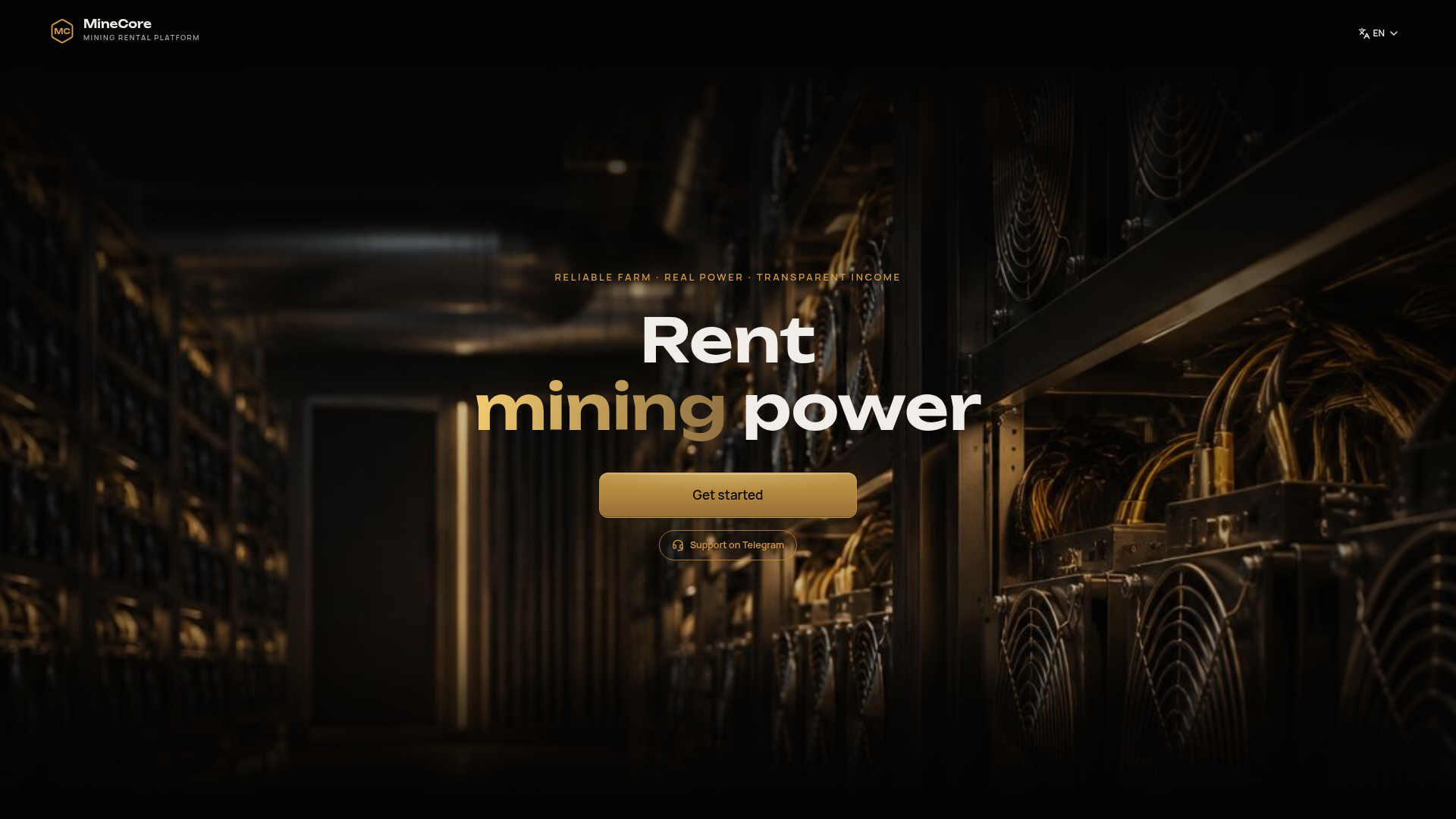
The operator describes infrastructure development beginning in 2016 and promotes rental as an alternative to buying hardware. A photograph of equipment illustrates that business model. Connecting a rental to actual work would require some way to identify the allocated capacity, the period of operation and a pool or other record of the work performed. The homepage did not independently establish a facility operator or a particular customer’s share of hardware.
The FAQ on myminecore.com opens its answer about guarantees affirmatively, then says accruals can change with network conditions and mining difficulty. Both parts matter. A promise to keep equipment running concerns availability. A commitment to pay a fixed number of dollars would concern what the customer receives. Ask which obligation appears in the signed rental and who bears the difference if mining proceeds fall short of the illustrated amount.
Renewal Can Hide the Settlement Question
At maturity, myminecore.com describes a choice between requesting USDT or moving the income into a balance for a new rental. Rolling a displayed amount into a new thirty-day contract is an internal accounting event. It leaves open whether the same balance could be sent to a wallet the customer independently controls. To measure what a rental actually produced, keep reinvestments, promotional credits and completed external payments on separate lines.
The referral offer introduces another revenue category. The site says a first rental by an invited friend triggers a bonus based on the package’s daily rate for seventy-two hours. That credit is associated with recruitment rather than mining work attributed to the original customer. Mixing the two makes it difficult to reproduce a claimed yield. The evidence guide can help keep a statement, referral entry and transaction receipt together.
Frequently Asked Questions
Does the Day-One Balance Show That Withdrawals Work?
The terms on myminecore.com say accrued income unlocks after thirty days. An early balance can help demonstrate how the interface represents earnings. It supplies no evidence of a withdrawal request being approved or tokens reaching a receiving wallet.
Which Record Would Resolve a Disputed Rental?
Start with the selected package, its activation time and the terms accepted. Then obtain the account history through maturity and the transaction identifier for any payment said to have been sent. A matching receipt is more informative than a cropped earnings figure.
Conclusion and Reporting Guidance
The rental arithmetic on myminecore.com is reproducible, but the mining work and the settlement of an individual rental remain open questions. Before paying, request the allocation record and the terms governing the original rental price. Someone already at maturity can preserve the withdrawal request before choosing renewal, then compare the final payout amount claimed with the amount actually received. How to report financial fraud · Submit a redacted rental record