
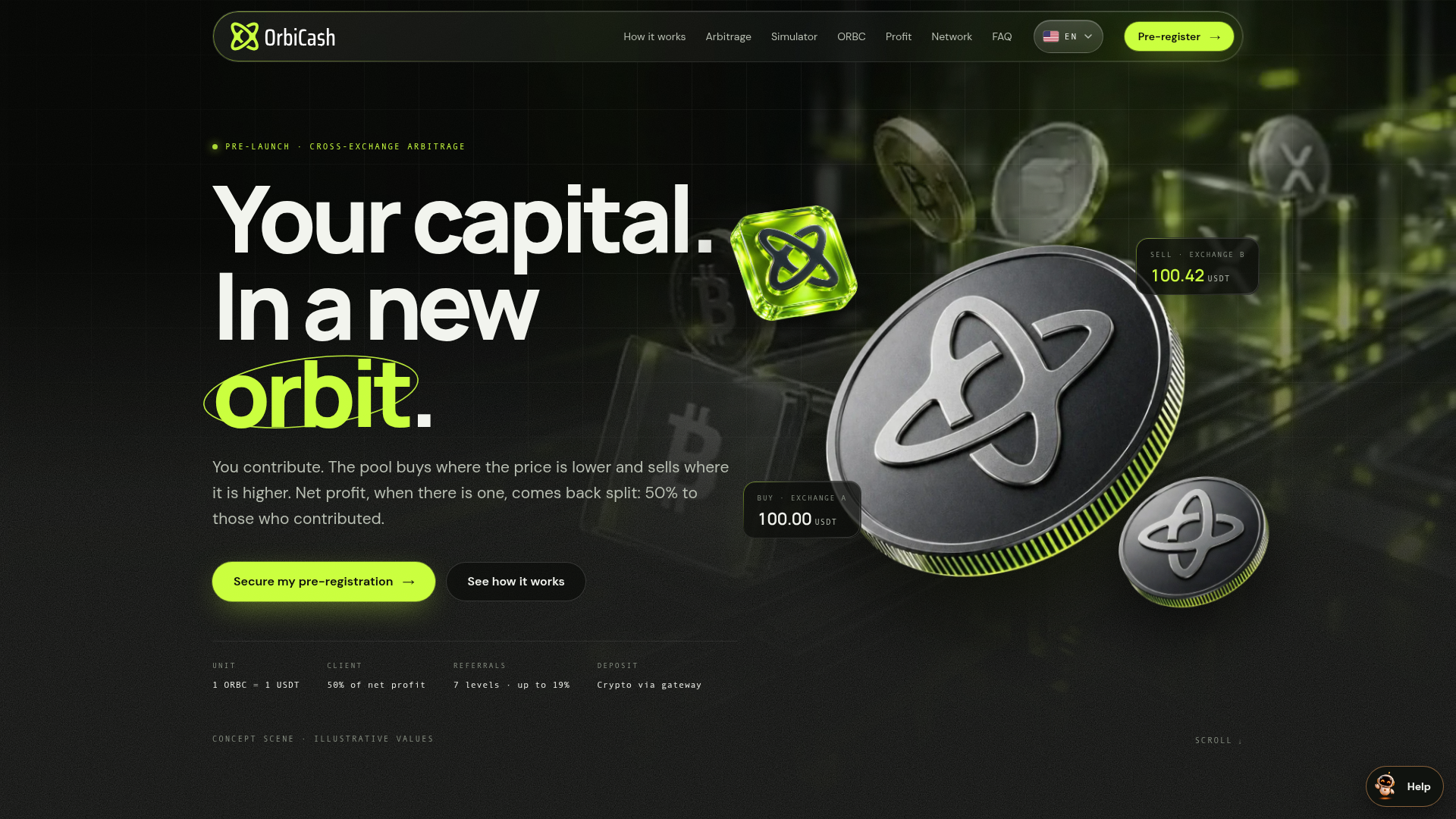
The public proposal on orbicash.app pools customer capital for cross-exchange arbitrage and divides completed net profit. OrbiCash calls its internal balance ORBC, gives it a one-to-one launch parity with USDT, and explicitly says it is recorded in a ledger. The economics depend on the pool’s actual execution and withdrawal conditions. orbicash.app orbicash prelaunch page
Customers are told they can allocate 25%, 50%, 75% or 100% of their balance. The operating company trades collectively, and the FAQ says an individual customer’s wallet does not directly communicate with an exchange. This places responsibility for execution and accounting with the operator.
ORBC balances generated by deposits and bonus balances are described as separately recorded. The site says a blockchain token launch would require legal advice and has no announced date or price. Readers therefore need an enforceable redemption agreement for the present ledger balance, including who owes the USDT equivalent.
The public description does not independently establish bank accounts, segregated customer wallets, exchange-account ownership or reserve coverage. A one-to-one accounting convention can describe how balances are entered while leaving those custody questions open. orbicash.app pool and orbc explanation
Profit Sharing Also Includes Losses
The stated distribution sends 50% of net profit to contributors, up to 19% to seven referral levels, and the remainder to the company. Missing or inactive referral levels increase the company share. The advertised level rates are 7%, 4%, 3%, 2%, 1%, 1% and 1%.
For orbicash.app, the loss rule deserves equal attention. Losses come out of pool capital in proportion to contributions. Referral commissions are said to arise only from realized profits, and arrive locked for initial use as trading capital.
The illustrative monitor displays accepted and rejected opportunities and explicitly identifies its figures as fictional. Its margins and timing ranges should retain that qualification. The reviewed page does not provide independently verified exchange fills that establish the same performance in a funded account.
Withdrawal Costs Change the Outcome
The withdrawal charge is 5% of the amount requested, with a minimum fee of 5 ORBC and manual approval. For a hypothetical 20 ORBC withdrawal, a five-unit minimum would consume 25% of the requested amount. For 100 ORBC, five units equal the advertised 5%. Withdrawal FAQ
The fee is separate from the share of trading profit retained by the company. A reader evaluating projected income needs both amounts, together with any bot costs. The public wording does not specify an approval deadline or resolve all conditions under which a withdrawal request could be delayed.
No withdrawal was requested during this review. In particular, the disclosure of manual approval is a contractual feature to investigate, without proving a refusal. Useful supporting records would include the original request amount, charged fee, approval time and actual external transfer.
Three Bot Scenarios on orbicash.app
OrbiBot Start costs $2 for thirty days, carries no daily fee and recommends a $40 balance. Its displayed projection reaches 15% under a combined overnight-bot and daytime-manual scenario. Explorer costs $8, recommends $100 and presents up to 17% with continuous bot coverage.
Advanced costs $19 for thirty days plus $0.20 per operated day, with a recommended $400 balance. The stated scenario is 20% at that amount and up to 21% at larger balances. The page says returns above the target stay with OrbiCash and acknowledges lower, zero or negative results.
That cap affects the description of a performance-fee-free bot. Even where no separately named performance fee applies, the published mechanism assigns above-target profit to the business. Readers should reconcile the cap, client profit split and withdrawal charge in a worked example before comparing plans.
Prelaunch Status and Accountability
The capture of orbicash.app invited preregistration and said no payment was required at that stage. It requested contact details and offered a referral code and launch-queue position.
The materials reviewed describe an operating company without independently establishing its legal identity or financial permissions. The displayed model and risk disclosures are useful evidence, but audited execution, ownership and the governing agreement remain unresolved. The crypto safety resource provides context for evaluating custody and wallet access.
Frequently Asked Questions
Is the Simulator a Record of Paid Returns?
The site labels its figures as simulated and excludes a guarantee. They illustrate assumptions about margins and activity, rather than documenting individual payments.
Can a Referrer Immediately Withdraw Every Commission?
The published description says commissions first arrive locked and are deployed as capital. The exact release procedure needs the full account terms before a recipient can assess access.
Does Preregistration Establish a Funded Investment?
The reviewed landing page expressly says preregistration carries no deposit. Any later payment invitation should be compared with the original disclosure and the legal agreement then offered.
Conclusion and Reporting Guidance
The clearest finding for orbicash.app is a disclosed profit-sharing model with capital losses, capped bot scenarios and a material minimum withdrawal fee. Execution evidence and legal accountability remain incomplete. Request a reconciled sample showing gross trade results through the final wallet payment before relying on projected income.
For an actual discrepancy, keep the applicable bot version and fee calculation. The reporting instructions and evidence guide explain how to assemble a claim with transaction records and the original terms.