
A business and an individual can read the same invitation to exchange cryptocurrency on retfin.company, yet the published complaint rules explicitly address individual users. That difference may only become apparent after a transfer needs tracing. The website also distinguishes a formal complaint from requests for proof of payment or the identity of a remitter. Understanding which process fits the problem is more useful than treating every message sent to support as the start of the same clock. Complaints and refunds handling rules
Start With the Cross-Border Notice
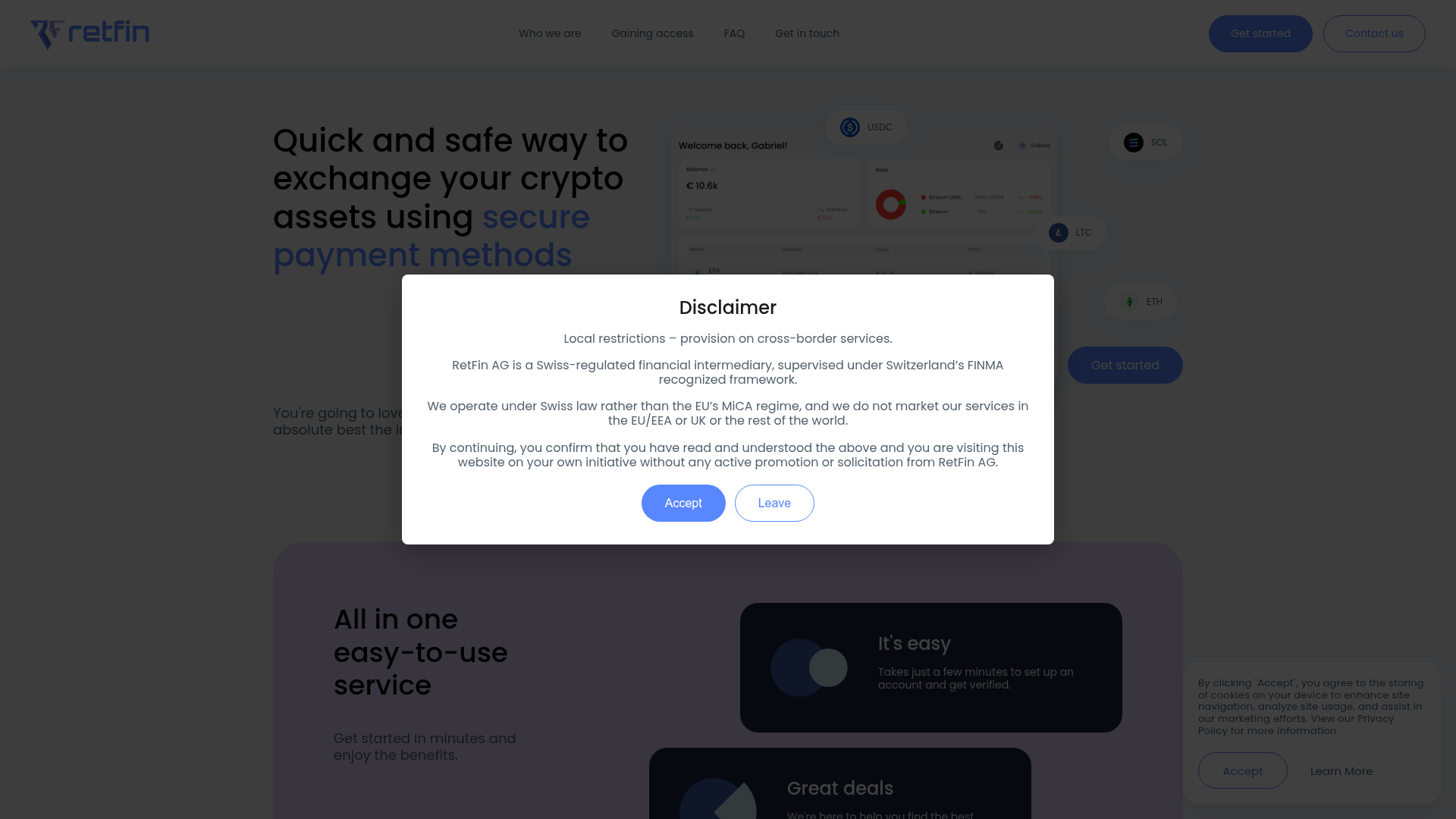
The November capture shows a disclaimer over the exchange homepage. It describes a Swiss financial intermediary and asks visitors to confirm that they came on their own initiative. It says services operate under Swiss law and that the company does not market them in the EU, EEA or UK. The notice documents the terms presented to a visitor. It cannot resolve whether a particular visitor was in fact approached by an advertisement, an introducer or a private message.
If a representative directed someone to retfin.company, retain the message and its date before trying to explain the introduction from memory. An unsolicited invitation and a visit initiated independently are different facts even if both eventually lead to the same acceptance button. Nothing in this review establishes which path a particular customer took. No customer account was opened and no exchange was placed.
The Company and the Membership Claim
The footer identifies Retfin AG, gives Swiss registration number CH-170.3.047.914-3 and lists Gotthardstrasse 26, 6300 Zug. A commercial-register summary independently identifies RetFin AG in Zug with UID CHE-171.184.345. Those identifiers belong to different numbering systems and need not look alike. The independent listing corroborates the company identity. It does not authenticate an email that invokes the company name or show who received a particular bank transfer.
The footer of retfin.company describes VQF self-regulatory organisation membership under number 101140. It is important to preserve the distinction between that stated relationship, Swiss corporate registration and any claim to a banking or investment licence. The review did not independently establish the current scope of the stated membership for each advertised service. Someone relying on it should request confirmation identifying the entity, activity and period being checked.
What Starts the Three-Month Clock?
The rules dated April 30, 2026 say an individual should complain within three months of becoming aware, or when they ought to have become aware, of an alleged violation of rights. The policy therefore ties its deadline to awareness. It does not simply say three months from opening an account or from every transaction. The dates of payment, first notice of a problem and first request for a remedy should be recorded separately.
The written process on retfin.company asks for the nature of the alleged breach, a description and supporting information. It permits an authorised representative but contemplates evidence of identity and authority. The rules list registered mail and a compliance email address. They say a refusal for procedural deficiencies will be communicated within seven business days. That is a timeframe for notice of a refusal under those rules, not a promise that every complaint will be resolved or a refund completed within seven days.
A Trace Request Is a Different Matter
The policy on retfin.company expressly excludes several types of requests from its definition of a complaint. Among them are requests for proof of a transaction, identification of a remitter or help identifying a recipient. An exchange customer trying to find a missing transfer might first need exactly that information. The exclusion explains why it is useful to state whether one is asking for a record or contesting a specific action by the company.
A business customer has an additional question. The sales materials mention business use while the first section of the complaint policy specifies individual users. A company considering the service can ask for the agreement and escalation path applicable to a corporate account before funding it. An individual already pursuing a complaint can retain proof of delivery and the date of acknowledgement. The reporting guide explains how to preserve the correspondence with payment evidence.
Frequently Asked Questions
Does the Swiss Company Record Establish a Right to a Refund?
It corroborates a legal identity. A particular refund depends on the transaction, the relevant agreement and the merits of the request. The existence of a refund policy on retfin.company cannot independently establish that a specific transfer should be reversed.
Which Amounts Should an Exchange Customer Keep?
Retain the amount and currency sent, the quoted rate, any disclosed spread and the amount received. Keep a bank reference or blockchain identifier as appropriate. Those details help distinguish a pricing dispute from an incoming transfer that the platform could not match to an account.
Conclusion and Reporting Guidance
The policy on retfin.company sets a three-month window for individual complaints while excluding several common payment-tracing requests. The route for a corporate customer and the precise regulatory scope still require confirmation. Identify the account holder and the remedy sought before choosing a channel. For an existing dispute, retain the quote, transaction record and dated explanation of when the issue first became apparent. How to report financial fraud · Submit a redacted exchange record