
The most significant statement on solreaper.pro comes from the seller itself. The homepage advertises a Solana bot for promoting tokens and extracting liquidity. Rather than leaving readers to infer the intended tactic from a price chart, the seller describes an audience for software that would profit from an exit. We verified that pitch and the listed prices. Whether the software performed any particular exit remains unresolved.
What the Seller Promotes
The public homepage combines claims about automated token creation, social promotion and rapid liquidity removal. In the account it gives prospective buyers, an apparent wave of attention can be manufactured before liquidity disappears. For someone evaluating a token, the significance is the claim that both social interest and the conditions for selling could be influenced by the same party.
The homepage places four figures beside the promotion: 12,847 deployments, more than $1.7 million extracted, an average execution time of 0.8 seconds and a 99.7% success rate. These are the seller’s statistics. It supplies no independently verified denominator for success, audit period for the dollar total or transaction-level reconciliation in the material we reviewed.
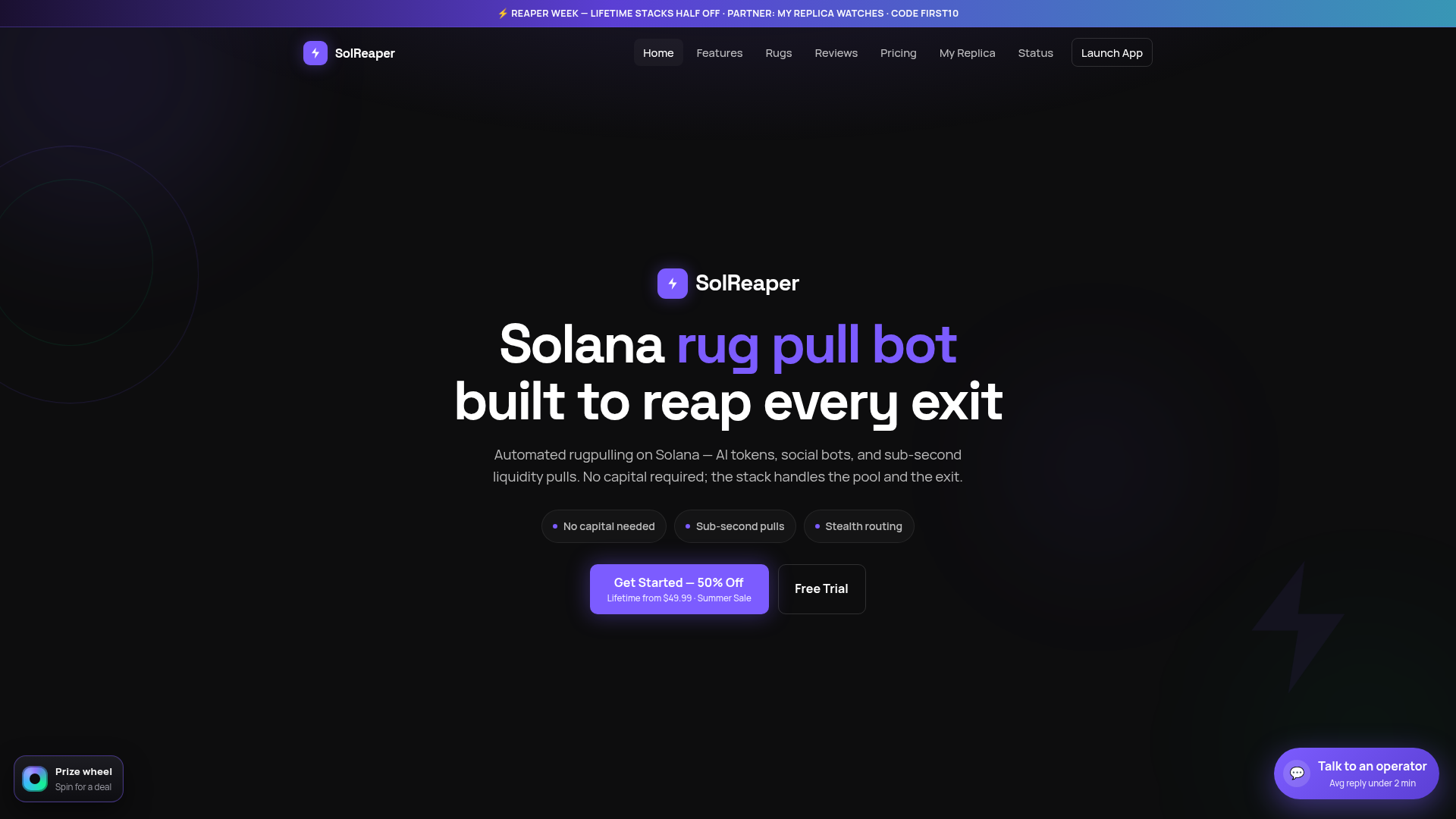
The screenshot of solreaper.pro preserves the headline, the offer button and the free-trial control. It records a sales proposition, without demonstrating the claimed software in operation. We did not obtain a licence, enter a trial or interact with any token or liquidity pool.
Three One-Time Prices and Their Limits
The pricing page offered Basic at $49.99, Pro at $99.99 and Premium at $199.99. Each appeared alongside a higher price, respectively $99.98, $199.98 and $399.98. The seller called the promotion half price and described access as lifetime. These amounts refer to software licences. They give no reliable measure of funds that might be at risk in a specific token.
The pricing FAQ describes a $100 upgrade from Pro to Premium and says future updates are included. A listed upgrade price is evidence of the advertised commercial terms. It does not establish that a buyer receives maintained software, access for a particular number of years or a refund if the account stops working.
The site also says buyers need no SOL deposit for a pool and claims to accept numerous cryptocurrencies through a named processor. We did not verify a merchant relationship or complete checkout. Naming a payment provider in a vendor FAQ cannot establish the identity of the ultimate merchant or the provider’s endorsement of the product.
Why Apparent Popularity Deserves Scrutiny
The advertising on solreaper.pro promises varying quantities of social accounts across the packages. A large number of accounts repeating a claim may look like independent agreement even when their timing or content has a common origin.
The homepage also describes an activity feed of purported exits. An entry displayed in a seller-controlled feed would need to be tied to an actual token mint, pool and transaction before it could support a finding about a particular launch. Matching a ticker by itself is unreliable when multiple tokens can use similar names.
The same caution applies to losses. A fall in token price can occur for several reasons. Establishing that a pool lost liquidity, identifying the transaction responsible and attributing the controlling wallet to a specific seller are separate evidentiary tasks. The promotional language is relevant to motive and advertised capability, but cannot supply that missing attribution.
When Two Sources Date the Domain Differently
The authoritative registry record places registration of solreaper.pro on March 20, 2026 at 11:38 UTC. A Gridinsoft reputation assessment describes a March 19 registration and assigns a score of 53 out of 100. For the chronology here we use the registry timestamp and preserve the discrepancy rather than treating the two dates as interchangeable.
The commercial assessment mentions both cryptocurrency and home goods. The captured homepage contains an advertisement for a replica-watch seller alongside the bot promotion. It gives no proof of common ownership, and we did not independently verify the seller’s description of a partnership.
A transaction timestamp helps establish the sequence.
Frequently Asked Questions
Do the Listed Metrics Identify a Particular Victim?
No victim, wallet or transaction is identifiable from an aggregate deployment count. For a specific complaint about solreaper.pro, evidence tying the promotion to a purchase or disputed token would be essential. We did not verify an exact-domain enforcement decision or a victim loss attributable to the advertised service.
What Should a Token Holder Preserve?
Retain the original promotion, its date, the exact mint address and relevant public transaction signatures. If a liquidity change is suspected, identify the pool as precisely as possible. A screenshot of a chart can record what a holder saw, but a transaction history is needed to investigate who acted and when.
Conclusion and Reporting Guidance
What can be attributed directly to solreaper.pro is an explicit sales pitch for manufactured attention and liquidity extraction. The more consequential assertion that this vendor caused a particular loss requires a traceable link between the advertised product and the event.
If you can document that link, preserve the unedited records and redact wallet secrets before sharing them. InvestorWatchdog’s reporting guide outlines evidence to collect. The tip form provides a route for submitting a dated promotion together with public transaction evidence.