
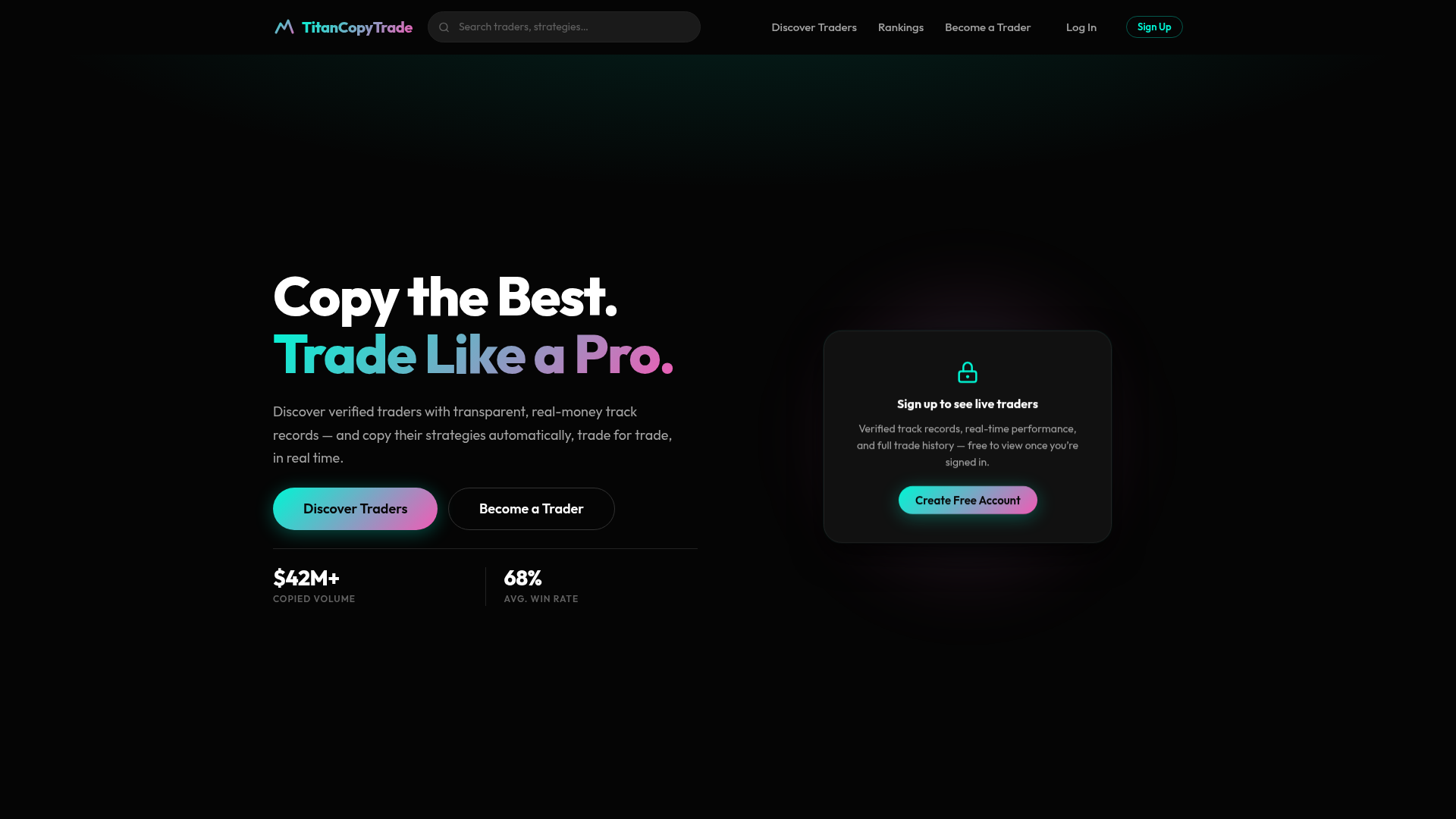
Sixty-eight winning trades out of a hundred can still leave a trader with a loss. That arithmetic matters on titancopytrade.com, where the homepage promotes a 68% average win rate alongside more than $42 million of copied volume. The same public screen asks visitors to sign up to see live traders. As a result, a reader encounters the aggregate figures before seeing the trade histories needed to reproduce them or the fee charged for copying any particular strategy. Homepage and sign-up prompt
Count Wins, Then Measure Their Size
Imagine a strategy closes sixty-eight trades with a gain of one dollar each and thirty-two with a loss of three dollars each. It wins on sixty-eight percent of trades but loses twenty-eight dollars overall before fees. This is an illustration of the metric, not a reconstruction of performance on the site. It shows why a prospective copier needs the distribution of gains and losses as well as the number of winning trades.
The public description on titancopytrade.com also leaves open what is being averaged. Taking the simple average of two traders’ percentages gives each trader equal weight. Combining every closed trade instead gives more weight to whoever traded more frequently. A calculation based only on active profiles can differ from one that retains discontinued strategies. To reproduce a published rate, a reader needs the dates, population of traders, treatment of open positions and definition of a win.
How Copied Volume Differs From Assets
The promotional volume figure on titancopytrade.com measures something different again. A dollar repeatedly used to open and close positions can contribute to turnover many times without adding another dollar of customer capital. Depending on the method, both entry and exit may count. The number does not establish how much money customers currently hold, how many investors made a profit or how much remains available for withdrawal.
The site also cites more than twelve thousand investors. Its public text gives no independent audit of the total or definition of a counted investor. A registered user, someone who browses profiles and someone who funds a copy allocation may represent different populations. Those definitions matter before using the stated user count and volume to infer a typical account size. This investigation did not sign in or obtain trade-level data from a customer.
Where the Fee Is Disclosed
The terms of service, updated August 26, 2026, say a performance fee is calculated on profits generated while copying a trader. They direct the reader to each trader’s profile for the applicable fee. They also say network and withdrawal fees may apply. The public terms do not supply one universal percentage that can be used to turn homepage performance into a net result.
A customer considering titancopytrade.com should establish the period over which profit is measured, how prior losses are treated and when the fee becomes due. A short winning period followed by a drawdown can produce different net outcomes depending on when a fee is taken. Keep the profile fee disclosure and calculation method in force when the allocation starts. A later profile or a screenshot of the headline win rate cannot substitute for those terms.
Who Controls the Copy?
The site says funds stay in the customer’s own wallet while positions are copied proportionally. It also says the customer can pause or stop copying. To assess what that means for a particular account, distinguish permission to open new trades from the authority to close existing positions or move funds. Stopping an instruction stream does not necessarily close every open trade. No wallet was connected, and the underlying permissions were not independently verified.
The terms on titancopytrade.com require traders seeking a profile to provide a verifiable record and disclose material strategy changes. That is a platform requirement. It is separate from an independent finding that every listed trader complied. A customer tracing a disputed fill can retain the original trader order, the copied order, their sizes, prices and timestamps. The evidence guide explains how to organize the records without sharing wallet secrets.
An export of closed positions should also identify any positions still open on the measurement date.
Frequently Asked Questions
Can Two Copiers Receive Different Returns From the Same Trader?
Yes. Different start times, allocations, execution prices and fees can produce different results. A trader’s published percentage cannot establish an individual customer’s outcome on titancopytrade.com without that customer’s account history and a reconciliation of deposits and withdrawals.
Does the Risk Disclosure Guarantee a Maximum Loss?
The terms say some or all of the allocated capital may be lost. They do not establish a separate guaranteed floor for every copied position. Confirm the actual controls and the consequences of stopping a strategy before treating a profile risk label as a contractual limit.
Conclusion and Reporting Guidance
The most consequential gap on titancopytrade.com is between an aggregate win rate and the net result available to an individual copier. The terms identify fees at profile level, while the public headline leaves the aggregation method unresolved. Before allocating capital, obtain the full period of trades and the applicable fee schedule. For an existing account, compare the trader’s fills with the trades actually copied. How to report financial fraud · Submit a redacted copy-trading statement