
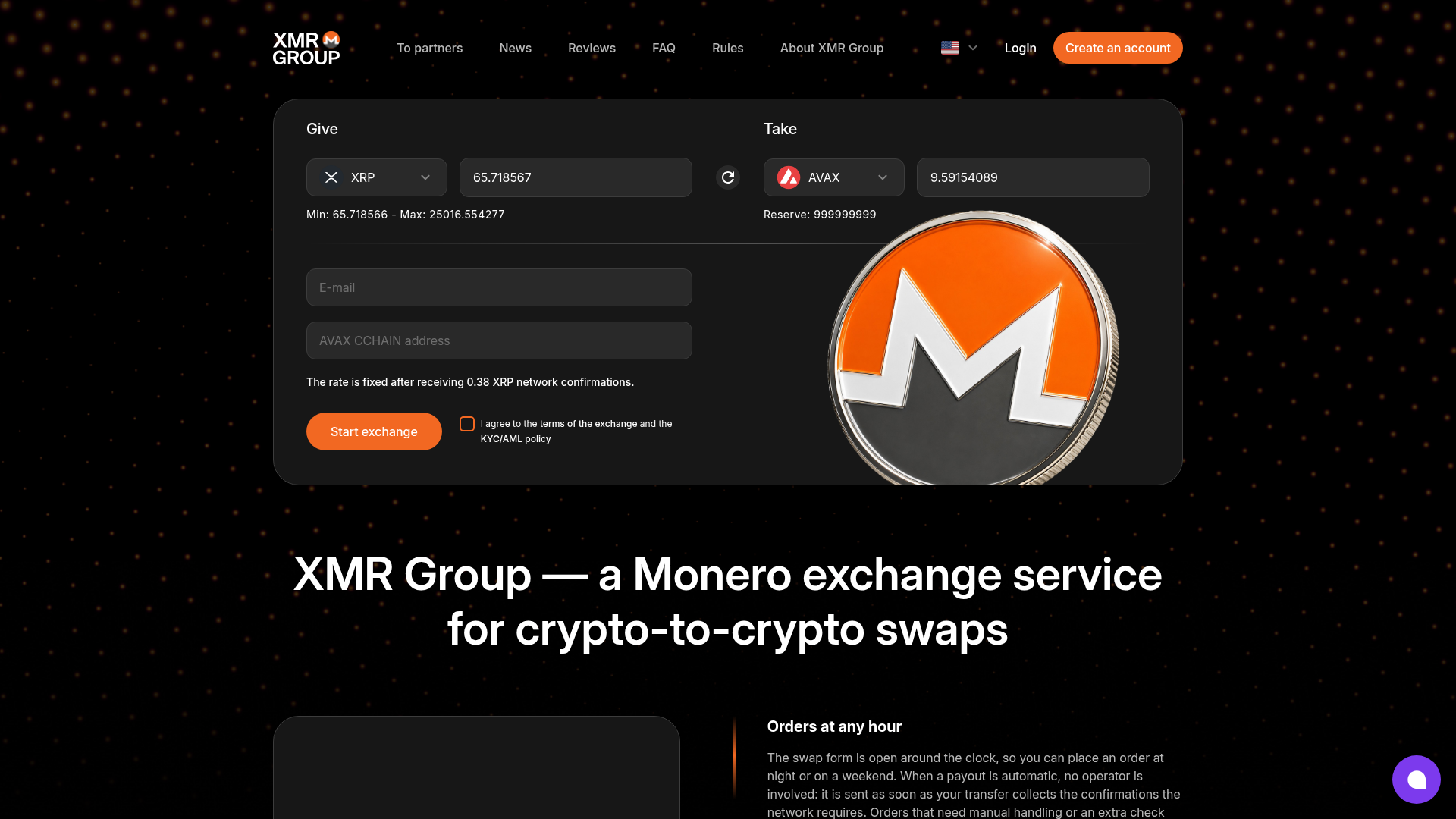
The name suggests a Monero exchange, yet a fresh visit to xmr.group opened an English-language quote for giving XRP and receiving AVAX. The final address retained both currency selections. That matters for anyone investigating a transfer: the rules and transaction identifiers needed for an XRP deposit and an Avalanche payout differ from those for a Monero payment. The visible pair is the right starting point, even when the service’s branding emphasises another asset. Captured quote
What Was Actually on the Ticket?
The captured form gave a minimum of 65.718566 XRP and a maximum of 25016.554277 XRP. It displayed an AVAX reserve of 999999999. These are interface values recorded on one visit. The reserve field is not an independently audited wallet balance. A reader cannot infer that an order of any size within the displayed range would have settled, or that the same numbers would appear for a different direction.
One line on xmr.group said the rate would be fixed after receiving “0.38 XRP network confirmations.” That wording combines what looks like a fractional asset amount with a count of confirmations. It does not give the reader a usable integer confirmation threshold. Someone relying on a quote should ask which event fixes the rate and retain the order-specific answer. It would be unjustified to silently rewrite the displayed figure as either a fee or a number of ledger closes.
An Order Without an Account Can Still Be Held
The service says users may place a swap without registering. Its AML and KYC policy says verification may be requested before completion, during processing or afterwards, and that an unanswered request can leave an order on hold. Those provisions explain why entering a receiving address and seeing a quote do not amount to an unconditional promise of an immediate payout.
The policy on xmr.group lists identity documents, evidence of control of a wallet and information about the origin of funds among possible requests. It says it does not ask for seed phrases, passwords or private keys. That last distinction gives a user a concrete way to evaluate an unexpected support message. A request for a private key conflicts with the stated procedure regardless of whether the sender uses the service’s name or logo.
Tracing Each Side of an XRP Swap
For the incoming leg, preserve the XRP destination and any destination tag supplied with the order. XRP Ledger documentation explains that a destination tag can identify the customer to credit at a shared address. A transfer can reach the right address while leaving an intermediary without the tag it uses to attribute that payment. Whether this particular order required one would need to be established from its own instructions. XRP Ledger documentation
For the outgoing leg, record the selected network and the full AVAX receiving address. A receipt for the incoming transfer establishes a different event from delivery to the outgoing address. If a user contacts xmr.group about a delay, the order number connects those two records. A screenshot showing only the balance of one wallet might omit the order reference, network or amount the service actually credited. Reporting a disputed transfer
Where the Exchange Qualifies Its Timing
The homepage says the form accepts orders around the clock. It distinguishes automated payments from cases requiring operators during working hours. The policy allows declines, holds and returns minus network fees where technically possible. It also permits blocking a transaction or account where risk remains unresolved. No transfer was initiated to measure how quickly an operator responds or whether a particular refund succeeds.
The domain record dates xmr.group to April 13, 2026. The documents refer to the XMR Group Administration, but the review did not independently establish a legal entity responsible for custody while a swap is pending. Registration of the address, a working support widget and a written compliance policy each supply useful identifying context. None independently proves availability of the displayed reserves or registration as a financial intermediary.
An order identifier from xmr.group connects correspondence to the site’s own ticket. The sending and receiving transaction identifiers serve a different purpose by allowing each transfer to be examined on its respective network. Use the reporting guide to keep all three references together.
Frequently Asked Questions
Does the Privacy of Monero Make an Order Anonymous?
The policy says its checks apply to Monero too. It describes circumstances where an operator might ask for proof of payment or a receiving address. A protocol’s privacy characteristics do not determine what an intermediary records about a customer’s order.
Is the Fee Shown Before Funds Are Sent?
The site says the quoted rate incorporates its fee. To investigate a discrepancy, keep the amount to be given, the amount expected, the fixing condition and any network fees. A later refund may involve a different deduction under the published policy.
Conclusion and Reporting Guidance
The combination of the XRP-to-AVAX ticket and the hold provisions on xmr.group gives readers a more precise picture than the Monero branding. Quote displays and policy wording are verified; counterparty identity and actual settlement remain open. Preserve both transaction legs and the order-specific terms before drawing conclusions about a shortfall. Submit an order and redacted correspondence